











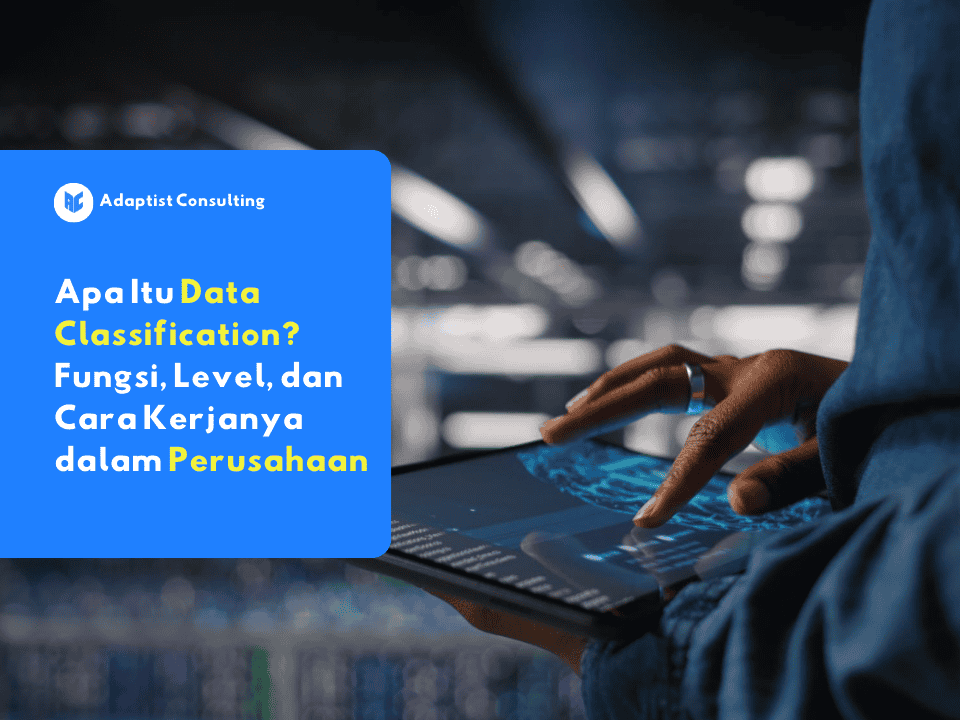
Data classification has become a valueable asset for organizations. Companies today manage data in large volumes from customer data, transaction, internal documents, to operational records. However, not all data carries the same value or risk. Many organizations assume that all data needs identical protection, but that is not the case. This situation can lead to high security costs, data breaches, and operational inefficiencies.
This is where data classification becomes the key to modern data security, not only to protect data but also to help companies manage risk, comply with regulations, and make better decisions.
What is Data Classification?
Data classification identifies, groups, and labels data according to its sensitivity, business value, and the potential risks if the information is leaked or misused. Through this process, organizations define how they must protect data, who can access it, and how systems store or transfer it.
Without data classification, organizations often apply the same security control to all data. However, this strategy is inefficient and may leave gaps in protecting the most important information. Classification helps companies understand what they have, where data resides, and what protection must be applied.
Why Data Classification Matters?
Data classification is not just a technical aspect, it also matters for business interests. Many security incidents occur not because of system weaknesses, but because organizations lack a deep understanding of the data they possess.
By performing data classification, companies gain clearer visibility into their information assets.
1. Provides Appropriate Protection for Sensitive Data
Customer data, financial reports, and identity records carry high risks if leaked. Without classification, many companies apply the same protection to all data, resulting in excessive controls for non-sensitive data or insufficient protection for critical data. It ensures precise protection, reduce costs, and minimizes incident risks.
2. Supports Regulatory Compliance (Personal Data Protection Law, GDPR, ISO, SOC2)
Modern regulations require companies to understand the types of data they manage. It becomes the foundations of every security control- ranging from encryption, access management, consent processes, to audit trails. With proper classification, companies have operational proof that compliance processes are executed consistently.
3. Reduces the Risks of Data Leaks
Data leaks often occur when organizations allow uncontrolled access to sensitive information that they have not properly labeled. With effective it, companies clearly define who can access specific data, how systems transfer that data, and when teams must delete it. This prevents misuse while minimizing damage if an accident occurs.
4. Optimizes Data Management
Without classification, companies store large amounts of data without clear priorities. This increases storage costs and slows down data audit processes. With classification, companies can determine which data must be retained, which can be archived, and which can be deleted. The result is much more efficient data management.
Learn about the PDP Law
The Personal Data Protection Law (UU PDP) regulates how personal data must be managed and protected, while also defining the rights of data subjects and the responsibilities of parties that process such data.
UU PDP
Deepen your understanding and explore the provisions in detail by downloading this PDF. Your data is safe with us!
What are the Data Classification Levels C1, C2, C3, and C4
The C1 to C4 classification model is used to group information based on its sensitivity and risk impact for the company. This approach enables organizations to know which data needs minimal protection and which data must receive strict security controls.
Typically, companies use the following levels:
1. C1 – Internal
C1 data refers to information intended for internal organizational use and has low risk if leaked to the public. Although the impact is not significant, this data should still not be accessed by outsiders.
Examples include internal regulations, work procedures, organizational structures, and operational documentation. Generally, C1 data only requires internal access limitations without high-level protection such as special encryption.
2. C2 – Confidential
C2 data includes information that can cause significant impact if misused or accessed by unauthorized parties. At this stage, security controls become crucial.
Examples include employee information, customer data, business contracts, and sensitive operational information. C2 data typically requires role-based access restrictions, activity logging, and tighter monitoring.
3. C3 – Restricted
C3 data refers to high-sensitivity information that can cause major losses- financial, legal, or reputational if leaked.
Categories include financial data, health information, authentication data, and other sensitive personal information. C3 data is usually protected with encryption, very strict access controls, and regular security audits.
4. C4 – Top Secret
C4 data is the most critical information in an organization. A leak at this level can directly affect business continuity or the strategic position of the company.
Examples include confidential business strategies, merger and acquisition plans, key intellectual property, and high-level executive data. Access to C4 data is very limited, strictly monitored, and typically involves additional security procedures.
Methods of Data Classification
Not all organizations have the same needs. Therefore, classification methods can be adapted to operational scale and complexity. Choosing the right method greatly influences the effectiveness of protection, compliance, and overall data management.
In general, there are three methods that companies commonly adopt when grouping data:
1. Manual Classification
Data grouping is conducted by the users or the data owners themselves. They group data based on their understanding of the context and the information content. The manual method has advantages in terms of contextual accuracy. However, this approach is difficult to apply consistently at a large scale and relies heavily on user awareness and discipline.
2. Automated Classification
This classification uses technology to detect spesific patterns, such as personal data, financial data, or other sensitive information. This process is much faster and more consistent than the manual method. However, automated classification requires good configuration and policies. Without proper settings, the classification results can be less accurate or too general.
3. Hybrid Classification
The hybrid method combines the advantages of manual and automated approaches. The system automatically groups the data first, and terms then validate or adjust the results when necessary. Modern organizations widely adopt this approach because it balances efficiency, accuracy, and control, especially in complex and constantly evolving data environments.
How to Implement Data Classification
Implementing data classification requires a structured and continuous approach.
1. Identify all data sources.
2. Establish classification categories and levels.
3. Create access policies based on sensitivity levels.
4. Apply automated labeling whenever possible.
5. Perform regular audits and updates.
With structured approach, it becomes a foundation for modern data security and compliance.
Conclusion
Data classification is not just about naming information. It is a crucial tactic for organizing security, risk, and compliance in a sustainable way. Without a comprehensive approach, it often functions only as a policy document. With the appropriate system support, it can serve as a strong foundation to protect company data.
Adaptist Privee helps organizations actively manage data classification, personal data protection, and regulatory compliance through a single integrated solution-ensuring that security moves beyond planning and is fully implemented.
FAQ
What is data classification?
Data classification is a method of grouping information based on vulnerability and potential risk to determine appropriate protection steps.
Why is data classification important for regulatory compliance?
The classification process helps organizations demonstrate that they handle and protect sensitive data in compliance with legal requirements.
Is data classification mandatory?
Although not clearly defined in regulations, in practice, it is very important for meeting PDP Law, GDPR, and other security standards.
Does data classification have to be manual?
Not necessarily. A mixed approach is recommended for organizations that want to operate efficiently and scale.