







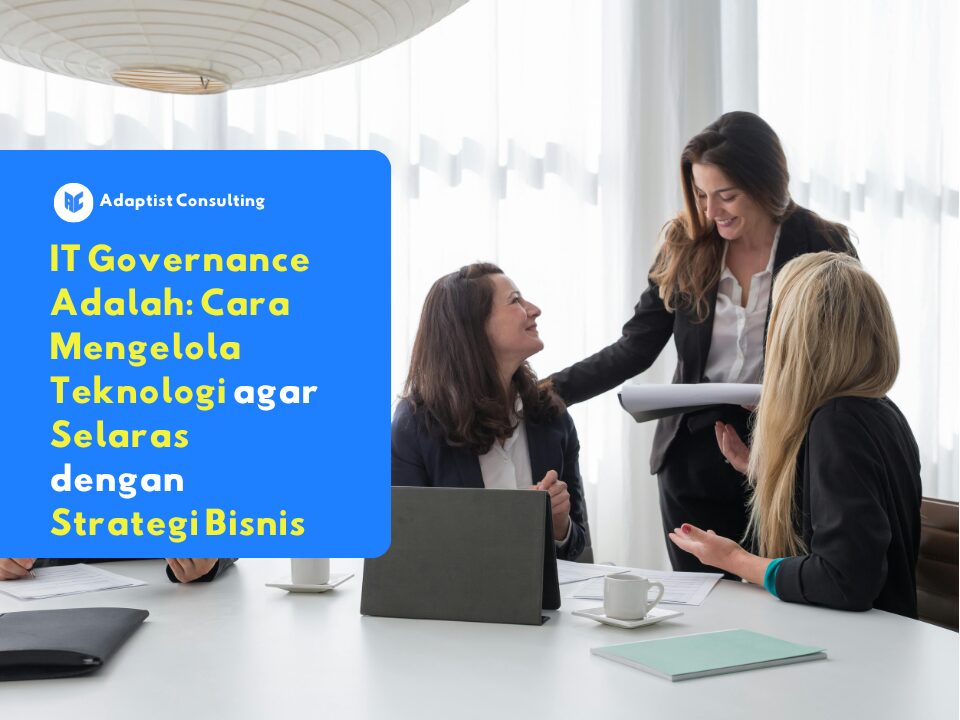
IT governance is a framework that ensures information technology is managed in a structured way and aligned with business objectives. It goes beyond systems, covering how IT decisions are made, who is responsible, and how risks are controlled.
In practice, IT governance helps companies prioritize technologies that deliver real operational impact. This business value can take the form of reduced infrastructure costs, faster processes such as order processing, and improved customer experience.
In addition, IT governance ensures that every use of technology can be monitored and evaluated. With proper control, companies can maintain efficiency and accountability across all IT activities.
Objectives of IT Governance
The main objective of IT governance is to ensure that technology contributes directly to business outcomes while keeping risks within an acceptable level (risk appetite). With proper governance, IT usage becomes more strategic rather than reactive.
Without clear objectives, technology investments may fail to deliver meaningful results. This is why IT governance plays a critical role in aligning IT decisions with overall business strategy.
Aligning IT with Business Strategy
IT governance ensures that every technology initiative is directly linked to business goals. This approach prevents systems from operating without a clear direction.
For example, a retail company aiming to increase online sales will prioritize the development of its e-commerce platform. IT decisions become more strategic because they directly support business targets.
Managing Technology Risks
Every system carries risks, from operational disruptions to cybersecurity threats. IT governance helps organizations identify and control these risks before they escalate.
Risk management is conducted within the company’s defined risk appetite. This structured approach allows businesses to maintain system stability without limiting innovation.
Improving Operational Efficiency
With proper governance, IT resources can be used more effectively. This helps reduce waste and improve overall productivity.
For instance, companies can eliminate redundant systems. As a result, operational costs such as servers and software licenses can be optimized.
Ensuring Regulatory Compliance
Organizations must ensure that their technology practices comply with applicable regulations. IT governance supports consistent compliance management.
For example, companies handling customer data must align their systems with regulations such as data protection laws. This helps avoid penalties and maintain customer trust.
Supporting Better Decision-Making
IT governance ensures that data is properly managed and can be used as a reliable basis for decision-making. This enables management to make more accurate business decisions.
With structured and reliable information, the risk of poor decisions is reduced. As a result, business strategies become more effective and measurable.
Optimizing Technology Investments
IT governance ensures that every IT investment has a clear purpose and delivers measurable value. This makes technology spending more controlled and efficient.
This approach positions IT as a business enabler rather than a cost center. Technology becomes a driver of growth instead of just an operational expense.
Key Pillars of IT Governance
In general, IT governance is built on five key pillars that guide how technology is managed. These pillars ensure that IT delivers not only functionality but also strategic value.
Each pillar is interconnected and essential for effective governance. Without one of them, the overall implementation may become less effective.
Strategic Alignment
This pillar ensures that IT strategy is aligned with business strategy. Every technology decision should support long-term organizational goals.
Without alignment, IT risks operating in isolation without delivering meaningful impact. This often leads to inefficient investments.
Value Delivery
Value delivery ensures that IT investments generate real business benefits. The focus is on achieving outcomes that justify the costs.
For example, automation systems that speed up order processing can significantly improve operational efficiency.
Risk Management
This pillar focuses on identifying and managing risks associated with technology. The goal is to keep risks within acceptable limits.
With this approach, companies can avoid major disruptions such as downtime or data breaches. Risks are managed, not eliminated.
Resource Management
Resource management ensures that IT assets such as infrastructure, applications, and human resources are used efficiently. This is essential for maintaining cost-effectiveness.
For instance, companies can allocate servers and IT teams based on business priorities. This prevents resource waste.
Performance Measurement
This pillar ensures that IT performance can be measured objectively. Metrics such as uptime, response time, and project success rates are commonly used.
These insights allow companies to evaluate whether IT systems are delivering value. If not, improvements can be implemented promptly.
Common IT Governance Frameworks
To implement IT governance effectively, companies often rely on standardized frameworks. These frameworks provide structured guidance for managing IT.
Using established frameworks allows organizations to avoid building governance systems from scratch. This accelerates implementation and reduces risk.
COBIT
COBIT is a framework focused on comprehensive IT governance and control. It is widely used for audits and ensuring IT compliance.
Many large organizations use COBIT to improve transparency and accountability. This makes IT processes more structured and reliable.
ITIL (Information Technology Infrastructure Library)
ITIL focuses on IT service management to ensure consistency and alignment with business needs. It helps improve service quality delivered to users.
For example, ITIL is used in incident management to resolve system issues quickly. This is crucial for maintaining operational stability.
ISO/IEC 38500
ISO/IEC 38500 is a standard that provides guidance for managing IT at the executive level. It focuses on decision-making and accountability.
This framework helps ensure that technology use remains aligned with business direction. It also minimizes the risk of strategic misalignment.
Examples of IT Governance Implementation
Understanding theory is not enough without practical application. Below are several scenarios illustrating how IT governance is applied in real business environments.
Each organization may implement governance differently depending on its needs and industry. However, the core principle remains the same: ensuring IT is controlled and aligned.
E-commerce Company Scenario
An e-commerce company sets uptime standards and implements real-time system monitoring. When disruptions occur, the IT team follows predefined procedures.
This approach ensures service continuity. As a result, customer experience remains stable and revenue loss is minimized.
Fintech Company Scenario
A fintech company applies strict access controls and data encryption to protect user information. All system activities are logged for audit purposes.
This helps reduce the risk of data breaches. It also prepares the company for regulatory audits.
IT Project Management Scenario
Before launching new IT projects, companies evaluate their business impact. This ensures that each project is relevant and goal-oriented.
With this approach, organizations can avoid investing in initiatives that do not deliver value. IT projects become more strategic and measurable.
Challenges in Implementing IT Governance
Despite its importance, implementing IT governance is not always straightforward. Many organizations face challenges during the process.
These challenges often arise from system complexity and rapid technological changes. Therefore, companies need a clear strategy to address them.
Lack of Business Alignment
Many organizations still separate IT from business strategy. This leads to systems that fail to deliver meaningful impact.
As a result, IT investments become less effective. In reality, technology should act as a business driver.
Technology Complexity
The more systems a company uses, the harder they are to manage centrally. This increases the complexity of governance.
Without proper integration, the risk of errors grows. Companies must ensure systems remain well-controlled.
Rapid Technological Change
Fast-paced technological advancements require companies to continuously adapt. Without updates, governance can quickly become outdated.
This makes regular evaluation of IT strategy essential. It ensures systems remain aligned with business needs.
Conclusion
IT governance is a critical foundation for ensuring that technology truly supports business strategy. Without proper governance, IT can become a source of risk and inefficiency.
With the right approach, companies can transform technology into a key driver of growth. IT is no longer just an operational tool, but a strategic asset that delivers real business value.
Ready to Manage Privacy Compliance as a Business Risk?
See how GRC helps map personal data risks, monitor compliance with the PDP Law, and prepare companies for audits without complicated manual processes.
FAQ
IT governance is a framework that ensures technology management aligns with business strategy, including decision-making, accountability, and risk control.
Because it ensures IT investments deliver business value, improve efficiency, manage risks, and maintain regulatory compliance.
The five main pillars are strategic alignment, value delivery, risk management, resource management, and performance measurement.