









DPIA: A Strategic Step to Control Data Protection Risks from the Start
February 20, 2026
OpenID Connect (OIDC) : Secure Solution for Single Sign-On (SSO)
February 24, 2026Chatbot vs AI Agent: Small Differences That Determine Big Efficiency
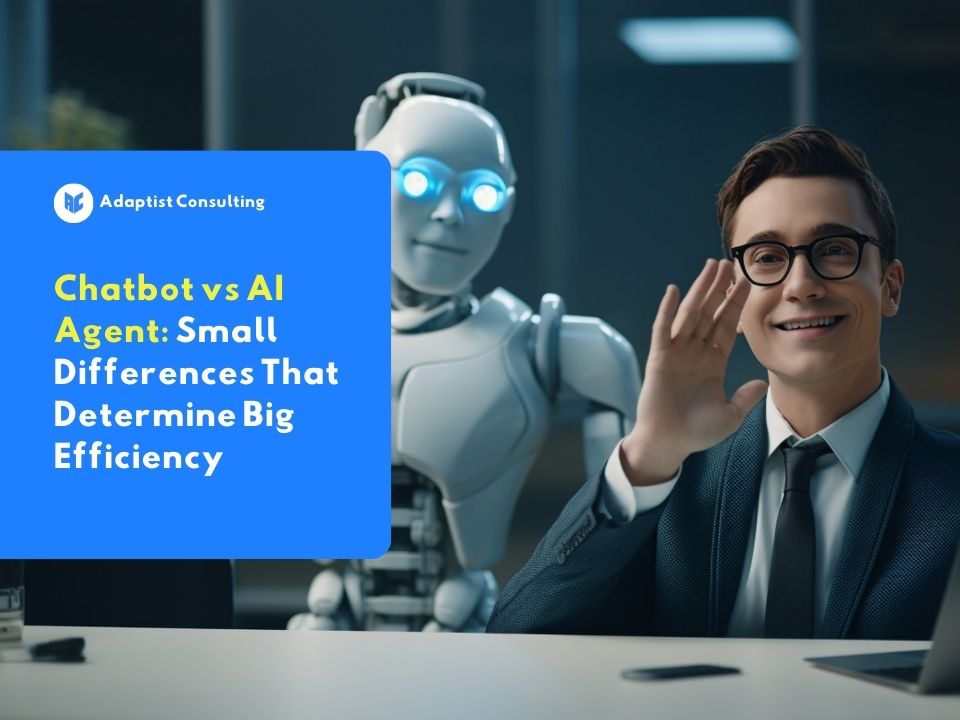
Chatbot vs AI Agent has become an increasingly discussed topic as the adoption of AI in business continues to grow. Many companies are now leveraging these technologies to improve customer service, yet some still assume they are the same solution. In reality, the differences between the two are quite clear and have a direct impact on business strategy.
When choosing between a chatbot or an AI Agent, the decision is not solely about adopting more advanced technology. It is also about alignment with operational needs, process complexity, and long-term business objectives. Selecting the wrong solution can result in partial automation that looks innovative but fails to solve real business problems.
What Is a Chatbot?
A chatbot is a system that uses artificial intelligence or predefined rules (rule-based systems) to communicate with users via text or voice. Chatbots are commonly used to handle frequently asked, simple, and structured questions, particularly across customer service channels such as live chat, WhatsApp, or websites.
Key Characteristics of Chatbots:
- Script or intent-based: Chatbots operate by following predefined conversation flows or recognized user intents.
- Focused on fast responses: The primary function of a chatbot is to deliver instant answers without involving human agents.
- Limited task scope: Chatbots typically handle a single, specific function, such as answering FAQs, checking order status, or providing product information.
Examples of Chatbot Use Cases:
- Providing information about business hours
- Sharing pricing or service details
- Directing users to specific web pages
In a business context, chatbots are often considered the first step toward customer service automation due to their quick implementation and relatively low cost.
What Is an AI Agent?
An AI Agent is a more advanced and autonomous AI system designed not only to respond to users, but also to make decisions and take actions based on context, data, and defined objectives. AI Agents can interact with multiple systems, learn from available information, and dynamically adjust their responses. Unlike chatbots, AI Agents are proactive and context-aware.
Key Characteristics of AI Agents:
- Reasoning and decision-making capabilities: AI Agents analyze situations and determine appropriate actions without relying on rigid scripts.
- Integration with multiple systems: Such as CRM, ticketing systems, ERP platforms, or knowledge bases.
- End-to-end problem-solving orientation
Examples of AI Agent Use Cases:
- Managing customer service tickets from start to finish
- Automatically escalating cases based on priority levels
- Providing action recommendations to human agents
AI Agents are better suited for businesses with complex processes and high interaction volumes that require advanced automation.
Chatbot vs AI Agent Key Differences
The difference between chatbots and AI Agents lies not only in technological sophistication, but also in their strategic roles within business operations. Understanding these differences helps companies choose the most appropriate solution based on process complexity and automation goals.
| Comparison Aspect | Chatbot | AI Agent |
|---|---|---|
| Primary Purpose | Provide quick responses to user inquiries | Execute tasks and business processes end-to-end |
| Level of Intelligence | Rule-based or basic NLP | Adaptive AI with reasoning capabilities |
| Interaction Style | Reactive, responds to user input | Proactive, able to initiate actions |
| Task Scope | Limited to specific scenarios | Multi-tasking and cross-functional |
| Adaptability | Restricted to predefined flows | Learns from data and context |
| System Integration | Typically standalone or limited | Integrated with CRM, ERP, ticketing, and other systems |
| Decision-Making | Does not make decisions | Analyzes situations and determines next steps |
| Scalability | Suitable for simple needs | Suitable for mid-sized to enterprise-scale operations |
| Business Role | Frontline customer interaction | Automation and business process orchestrator |
Optimize Your Customer Service
Schedule a demo of Adaptist Prose and see how an integrated ticketing system helps bring tickets, conversations, and customer data together in a single dashboard. With a more structured workflow, teams can respond faster, reduce operational burden, and maintain consistent service quality as the business grows.
Similarities Between Chatbots and AI Agents
Despite significant differences in intelligence and functionality, chatbots and AI Agents share several important similarities. These similarities indicate that both belong to the same AI technology spectrum and often complement each other within business automation strategies.
Referring to insights from ServiceNow, the following are the key similarities between chatbots and AI Agents:
1. Use Artificial Intelligence Technology
Both chatbots and AI Agents rely on artificial intelligence as their foundation, particularly Natural Language Processing (NLP) to understand human language. While their sophistication levels differ, both are designed to identify user intent and deliver relevant responses, enabling more natural interactions compared to traditional menu-based systems.
2. Automate Business–User Interactions
Both technologies aim to reduce the need for manual human interaction. Chatbots and AI Agents allow customers to receive answers or solutions without waiting for customer service representatives. From a business perspective, this automation directly improves team productivity and lowers operational costs.
3. Operate Across Multiple Digital Channels
Chatbots and AI Agents can be deployed across various digital touchpoints, including websites, mobile applications, WhatsApp, email, and internal enterprise platforms. This cross-channel consistency helps businesses create smoother and more integrated customer journeys.
4. Improve Service Speed and Availability
One of the most important similarities is their ability to deliver 24/7 service. Both chatbots and AI Agents can respond to customer requests at any time, regardless of business hours. This responsiveness significantly improves customer satisfaction, especially in high-volume service environments.
5. Reduce Operational Workload
By handling routine and administrative tasks, chatbots and AI Agents enable internal teams to focus on higher-value, strategic work. Human agents can dedicate their efforts to complex cases that require empathy, negotiation, or nuanced judgment rather than repetitive inquiries.
6. Can Be Combined Within a Single Automation Ecosystem
In best-practice implementations, chatbots and AI Agents do not operate in isolation. Chatbots often serve as the first interaction layer, while AI Agents take over when deeper processing or decision-making is required. This combination creates a more flexible and scalable automation system.
7. Support Data-Driven Decision Making
Both technologies can collect and analyze interaction data. This data helps businesses understand customer needs, identify process bottlenecks, and refine service strategies. As a result, chatbots and AI Agents function not only as operational tools but also as valuable sources of business insights.
Read Also: The Overlooked Role of AI Chatbots in Predictive Customer Support
Considerations When Choosing Chatbot vs AI Agent for Business
Choosing between a chatbot and an AI Agent is a strategic decision that can reshape how businesses interact with customers, manage internal operations, and scale in the future. Based on perspectives shared by Cognigy, the following factors should be carefully evaluated before selecting the right solution.
1. Business Process Complexity
The first step is assessing how complex the processes are that need automation. If the goal is simply to answer common questions or provide basic information, a chatbot is often sufficient.
However, if the process involves multiple variables, data validation, decision logic, and potential escalation, an AI Agent is the better option due to its ability to handle complex, non-linear workflows.
2. Volume and Variety of User Interactions
Businesses with low interaction volumes and relatively uniform inquiries can safely rely on chatbots. In contrast, organizations handling thousands of interactions across diverse cases benefit more from AI Agents, which can categorize cases, assign priorities, and tailor responses based on user context.
3. Need for Internal System Integration
Chatbots typically act as a recognizable front-end interaction layer with limited integration. AI Agents, on the other hand, are designed to directly connect with internal systems such as CRM, ERP, HRIS, or ticketing platforms. If automation is expected to execute processes not just respond system integration becomes a critical factor favoring AI Agents.
4. Scalability and Long-Term Vision
Chatbots often serve as short-term or tactical solutions. However, if a company plans to expand services, add communication channels, and automate cross-departmental processes, AI Agents offer greater flexibility. Choosing a solution aligned with long-term growth helps avoid costly system migrations in the future.
Conclusion
Chatbot vs AI Agent is not about determining which technology is universally superior, but rather which solution best fits specific business needs. Chatbots excel in speed and simplicity, while AI Agents deliver intelligence, flexibility, and scalability.
For growing businesses, chatbots can be an effective starting point. However, for organizations aiming to build sustainable, data-driven automation, AI Agents represent a more strategic long-term investment.
As a next step, businesses do not have to navigate AI transformation alone. Partnering with a team that understands business context, organizational readiness, and technology roadmaps is essential to ensure that chatbot or AI Agent implementations deliver real value. With a strategic, needs-based approach, Adaptist Prose helps organizations design, implement, and optimize AI solutions aligned with long-term business goals, moving beyond trends to build sustainable, high-impact automation.
FAQ
For small businesses with simple customer service needs, chatbots are usually sufficient. AI Agents are better suited for businesses with complex processes, high interaction volumes, and extensive system integration requirements.
AI Agents are not designed to completely replace humans, but to support and accelerate team performance. Human roles remain essential for strategic decision-making, empathy, and handling complex cases.
Yes. Many businesses combine chatbots as frontline solutions for simple inquiries and AI Agents for handling advanced processes. This approach creates a more flexible and scalable automation framework.