







Vulnerability: Definition, Types, and Its Dangers to Business
January 8, 2026
Digital Governance Is an Essential Framework
January 8, 2026Social Engineering: Definition, Impact, and Prevention
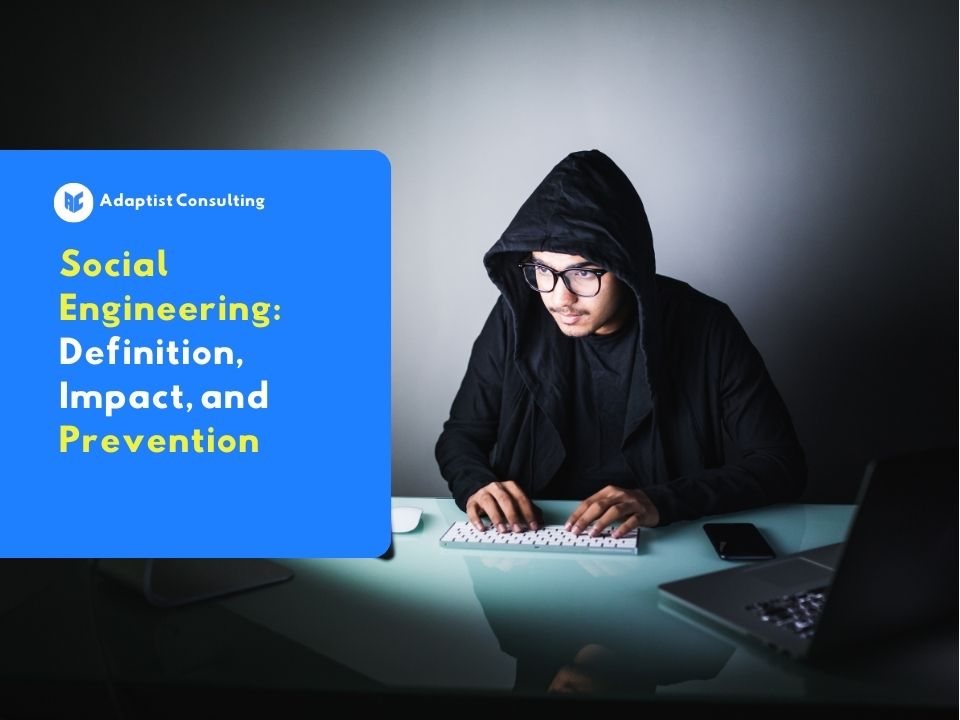
In the modern security world, protection technologies considered impenetrable often fail against the most fundamental vulnerability: human error.
Social engineering is a manipulation technique targeted at an individual (employee) to coerce them into divulging confidential information or performing actions that compromise corporate security systems.
Unlike other hacking methods that generally seek gaps by cracking software code, these attacks target human psychological aspects, such as fear, urgency, or simply the desire to help.
For enterprise-scale companies, understanding the mechanism of this attack is no longer just additional knowledge, but the primary foundation of a data defense strategy.
What is Social Engineering?
Social engineering is a psychological manipulation technique used by cybercriminals to deceive users into making mistakes—whether intentionally or unintentionally—that can damage security systems.
The objectives vary widely, ranging from tricking an employee into infecting a device with malware to stealing access credentials to infiltrate a corporate network.
Attackers do not need to break complex encryption if they can convince your employee to hand over a password voluntarily.
These attacks are dangerous because they rely on human interaction and often involve emotional manipulation that is difficult for standard security software to detect. Therefore, a technical security approach alone is no longer sufficient to mitigate this risk.
How Social Engineering Attacks Work
Social engineering attacks do not happen instantly; they follow a well-planned lifecycle. Understanding this cycle can help your security team detect attack patterns before damage occurs.
Generally, these attacks involve four main stages:
- Investigation: The attacker gathers background information about the target, such as organizational structure or employee habits on social media.
- Hook: The attacker makes initial contact and establishes trust or creates a plausible scenario (pretexting).
- Play (Execution): Once the target is hooked, the attacker manipulates the victim into performing the desired action, such as downloading a file or transferring funds.
- Exit: The attacker removes digital traces and closes the interaction as if nothing happened.
Types of Social Engineering Attacks
Cybercriminals continue to diversify their methods, moving from simple emails to AI-based voice manipulation and physical exploitation.
Here is a complete mapping of social engineering attack types that every organization must watch out for:
| Tipe Serangan | Deskripsi Mekanisme | Contoh Skenario B2B | Strategi Pertahanan Utama |
|---|---|---|---|
| Phishing | Sending mass messages masquerading as legitimate entities to lure victims into providing sensitive data. Relies on quantity (“spray and pray”). | Mass emails claiming to be from “Admin Office 365” requesting immediate account verification due to “suspicious activity.” | Advanced email spam filters and routine phishing simulation training. |
| Spear Phishing / Whaling | Highly targeted phishing variants. Spear Phishing targets specific individuals, while Whaling targets C-level executives (CEO, CFO). | Email to the CFO appearing to come from the CEO, requesting an urgent fund transfer to a new vendor for a “confidential project.” | Double payment verification procedures and use of encrypted digital signatures. |
| Baiting (Umpan) | Luring victims with promises of free goods or curiosity using physical media or infected digital downloads. | A USB drive labeled “Annual Bonus 2025” left in the office lobby. When plugged in, malware infiltrates the network. | Policy banning the use of external media (USB) without IT team scanning. |
| Pretexting | Attackers create a false scenario (pretext) and a convincing persona to manipulate victims into leaking personal data. | Caller claims to be from HQ HR needing confirmation of ID numbers (NIK) and birth dates for “health insurance updates.” | Verify the caller’s identity through official channels before providing any data. |
| Quid Pro Quo | Offering a service or benefit in return. Unlike baiting (goods), this involves services. | Caller claims to be IT Support offering a “quick security patch” on the condition the victim turns off their firewall. | Educate employees that official IT Support will never ask for passwords or disable security via phone. |
| Tailgating / Piggybacking | Infiltrating restricted physical areas by following someone with legitimate access (access card/RFID). | Someone dressed as a courier asks an employee to hold the lobby door open because their hands are full. | Implementation of centralized employee access systems and a “one card, one person” policy. |
| Vishing (Voice Phishing) | Phishing using phone calls or voice messages. Now often enhanced with Deepfake Audio technology to mimic superiors’ voices. | A call from a “Director” sounding panicked, asking finance staff to process a fictitious invoice immediately. | Callback procedures to official internal numbers to verify verbal instructions. |
| Smishing (SMS Phishing) | Phishing attacks via short messages (SMS) or chat apps (WhatsApp/Telegram), often containing malicious short links. | SMS: “Your office package is held. Click this link to pay customs duty.” | Never click links from unknown numbers; verify via the vendor’s official app. |
| Watering Hole | Infecting third-party websites frequently visited by specific targets (e.g., industry forums or local news portals). | Injecting malicious code into a logistics industry news portal to target supply chain managers visiting the site. | Ensure browsers and OS are always patched and restrict web access from critical servers. |
| Business Email Compromise (BEC) | Hacking or spoofing business email accounts to commit financial fraud. This is a high-level form of impersonation. | Attackers hack a genuine vendor’s email, then send an invoice with an altered bank account number to your company. | Confirmation of vendor bank account changes must be done via phone (not email) with multi-level approval. |
| Scareware | Malicious software that scares victims with fake security warnings to make them buy fake “cleaner” software. | Browser pop-up flashing red: “YOUR SYSTEM IS CRITICAL! Download Antivirus X now to prevent data loss.” | Educate users to force-close browsers when seeing pop-ups and only use centrally managed corporate antivirus. |
| Dumpster Diving | Physical method of searching for information (paper, old hard drives) in company trash for Social Engineering material. | Searching for internal memos or post-its containing passwords thrown away carelessly to construct attack scenarios. | Clean Desk Policy and confidential document shredding before disposal. |
Real-World Social Engineering Case Studies
Many organizations assume they are “too big to be tricked.” However, facts show that companies with the largest cybersecurity budgets can be crippled by a single human interaction loophole.
Here are two phenomenal cases proving how crucial identity protection is:
1. MGM Resorts (2023): Destruction via Phone Call
In September 2023, casino and hospitality giant MGM Resorts suffered a cyberattack that paralyzed hotel operations, digital room keys, and casino slot machines for days.
Modus Operandi: The hacker group (Scattered Spider) did not use sophisticated code to enter. They simply opened LinkedIn, found the name of a senior employee, and called the company’s IT Helpdesk (Vishing).
The attacker convinced IT staff that they were the employee who “forgot their password” and lost access to their device. IT staff then reset login credentials and removed old MFA protections, giving the attacker “red carpet” access to the entire network.
Estimated Loss: $100 Million USD and massive reputational damage.
2. Uber (2022): “MFA Fatigue” Attack
Uber was successfully breached by an 18-year-old teenager using a psychological manipulation technique known as MFA Fatigue or MFA Bombing.
Modus Operandi: The attacker, already possessing an employee’s password (from a third-party data leak), attempted to login repeatedly. The employee kept receiving login approval notifications (MFA) on their phone.
Initially, the employee refused, but the attacker then contacted the employee via WhatsApp, claiming to be IT security staff, and asked them to “approve the notification to stop the disturbance.” Out of fatigue and trust, the employee pressed “Approve.”
Impact: The attacker gained full admin access to cloud infrastructure, source code, and Uber’s internal systems.
Important Lessons for Access Security
Both cases above confirm one thing: Standard passwords and MFA are not enough.
The MGM case demonstrates the need for strict Identity Governance in password reset procedures, while the Uber case proves the importance of intelligent systems (Adaptive Auth) that can detect unreasonable access request anomalies.
This is where technology plays a role in closing gaps left by human negligence. These cases prove that identity validation and user habits that weaken security systems are a company’s biggest loopholes.
Impact of Social Engineering Attacks on Companies
The impact of a successful social engineering attack can be devastating, extending beyond direct financial loss.
Operational Loss: Disruption to IT systems can halt productivity for days or weeks.
Reputational Damage: Loss of trust from clients and business partners is a long-term impact that is hard to recover.
Regulatory Sanctions: Personal data leakage due to negligence can trigger massive fines under UU PDP No. 27 of 2022.
This is why the integration between cybersecurity and compliance management through Enterprise Identity Governance is crucial.
How to Prevent Social Engineering (Social Engineering Defenses)
Given its nature of targeting humans, the best defense is a combination of technology, policy, and education. Here is a layered defense strategy your organization can implement:
1. Education and Security Awareness Training
Your employees are the first line of defense as well as potential points of failure.
Conduct periodic phishing simulations to train staff vigilance against suspicious emails.
Cultivate healthy skepticism; employees should feel comfortable verifying unusual requests, even if they come from senior executives.
2. Identity Verification and MFA
If education fails and an employee hands over their password, technology must be ready to serve as a safety net.
Implementation of Multi-Factor Authentication (MFA) is mandatory.
MFA ensures that a password alone is not enough to grant access to company systems.
For maximum protection, companies need to implement the best MFA for enterprise that supports adaptive authentication methods, so suspicious access requests can be blocked automatically.
3. Use of Access Management Security Software
Use advanced email filters to detect spam and malicious links before they reach employee inboxes.
Additionally, limit employee access rights using the Least Privilege principle.
Modern IAM (Identity and Access Management) solutions can help you manage user lifecycles and prevent unauthorized access privilege escalation.
This aligns with effective incident management practices to detect user behavior anomalies in real-time.
Conclusion
Social engineering will continue to evolve, exploiting every psychological gap and new technology like AI.
Organizations cannot rely solely on network firewalls; you must strengthen the “human firewall” and layer it with strict access controls.
This is where the role of identity management technology becomes vital. Adaptist Prime serves as a holistic IAM solution designed to mitigate access risks resulting from social engineering. With Conditional Access and MFA features, Prime ensures that stolen credentials do not automatically provide a red carpet for attackers to enter your system.
Combining human vigilance with intelligent security platforms is the only way to survive the current threat landscape.
FAQ about Social Engineering
1. Can antivirus prevent social engineering?
Antivirus can detect malware downloaded as a result of an attack, but it cannot prevent the psychological manipulation that makes users hand over data voluntarily.
2. What is the difference between Phishing and Social Engineering?
Social engineering is the umbrella term (category), while phishing is one specific method within that category.
3. Who is most vulnerable to these attacks in a company?
All levels are vulnerable, but HR and Finance departments are often primary targets due to their access to sensitive data and company funds.
4. Does a VPN protect against social engineering?
Not directly. A VPN encrypts your internet connection, but if you are tricked into entering credentials on a fake site through that VPN connection, your data will still be stolen.
With the support of Adaptist Prime, your company can build a digital ecosystem that is secure, time-efficient, and ready to grow without sacrificing data protection or user convenience.