









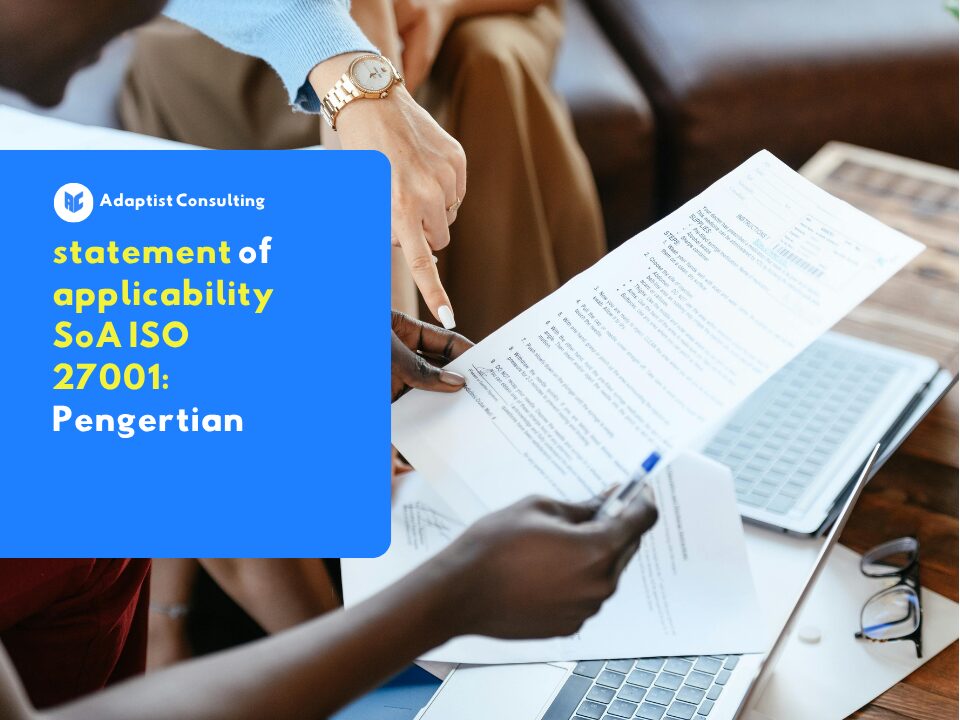
Statement of Applicability (SoA) is one of the key documents in the ISO 27001 standard used to define the information security controls implemented within an organization. This document is an essential part of the Information Security Management System (ISMS) because it shows how an organization manages risks in a structured way.
SoA does not only list the selected controls, but also explains the justification for including or excluding each control based on risk assessment results. In this way, the document provides a comprehensive overview of the organization’s information security approach.
In addition, the Statement of Applicability serves as formal evidence that the organization has considered all relevant controls in Annex A of ISO 27001. This makes SoA very important in audit and certification processes. Without this document, it would be difficult for an organization to demonstrate compliance with the international standard.
Functions of Statement of Applicability (SoA)
The functions of the Statement of Applicability are as follows:
Basis for Security Control Implementation
SoA serves as the main reference for determining which security controls should be implemented within an organization. Each selected control is based on a prior risk assessment process.
This helps organizations avoid unnecessary or irrelevant controls. As a result, resources can be used more efficiently in managing information security.
In addition, SoA ensures that all implemented controls have a clear purpose. This makes the security system more structured and easier to evaluate.
Supporting ISO 27001 Compliance
SoA is one of the key documents required during ISO 27001 audits. Auditors will review whether the implemented controls align with the standard and are supported by risk analysis.
This document also proves that the organization applies a risk-based approach to information security management, which is the core principle of ISO 27001.
With SoA, organizations can clearly demonstrate compliance with international standards. This is especially important for companies seeking or maintaining certification.
Communication and Audit Tool
SoA also functions as a communication tool between management, IT teams, and external auditors. It clearly explains which controls are applied within the organization.
Furthermore, it helps align understanding among stakeholders regarding the organization’s security posture. This reduces miscommunication in control implementation.
With clear documentation, audit and evaluation processes become more efficient since all parties refer to the same document.
Example of Statement of Applicability (SoA)
Control Structure in SoA
SoA is typically structured as a table containing a list of controls from ISO 27001 Annex A. Each control has an implementation status indicating whether it is applied or not.
In addition, there is an explanation column that describes the justification for including or excluding each control. This structure helps auditors understand the reasoning behind each decision.
The document may also include references to supporting policies or procedures. This makes the SoA more complete and verifiable.
Example of SoA Implementation in an Organization
For example, a data encryption control may be marked as “implemented” if the organization uses encryption to protect sensitive data. This shows that data breach risks are properly mitigated.
On the other hand, some controls may be marked as “not applicable” if they are not relevant to the organization’s context. For instance, certain physical security controls may not be required if the organization operates fully in a cloud-based environment.
This approach shows that ISO 27001 is flexible and adaptable to organizational needs. However, every exclusion must be properly justified.
Importance of Regular SoA Updates
The Statement of Applicability is not a static document and must be updated regularly according to changes in risks and systems. Any technological or business process changes should be reflected in the SoA.
Regular updates are important to ensure that security controls remain relevant to current conditions. Without updates, organizations risk using outdated and ineffective controls.
In addition, updating SoA is part of continuous improvement in ISMS. This ensures that the security system evolves alongside emerging threats.
Conclusion
The Statement of Applicability (SoA) is an essential document in ISO 27001 used to document security controls implemented in an organization based on risk assessment results.
It not only serves as proof of compliance with the standard but also helps organizations manage information security in a systematic, transparent, and efficient manner.
With SoA, organizations can ensure that every risk has appropriate controls and that these controls are continuously updated according to system changes and emerging threats.
FAQ
The main function of SoA is to serve as a reference for implementing security controls, provide evidence of ISO 27001 compliance, and act as a communication tool between internal teams and auditors. It ensures that every risk has appropriate controls in place and supports a systematic risk-based security approach.
Yes, SoA should be updated regularly in response to changes in risks, technology, and business processes. Any changes affecting information security must be reflected in the document. Regular updates ensure that controls remain relevant and effective.
Statement of Applicability (SoA) is important because it provides clear documentation of which security controls are applied and why they are included or excluded. It helps organizations demonstrate compliance with ISO 27001 during audits. In addition, SoA ensures that risk management decisions are transparent, structured, and aligned with business needs.