










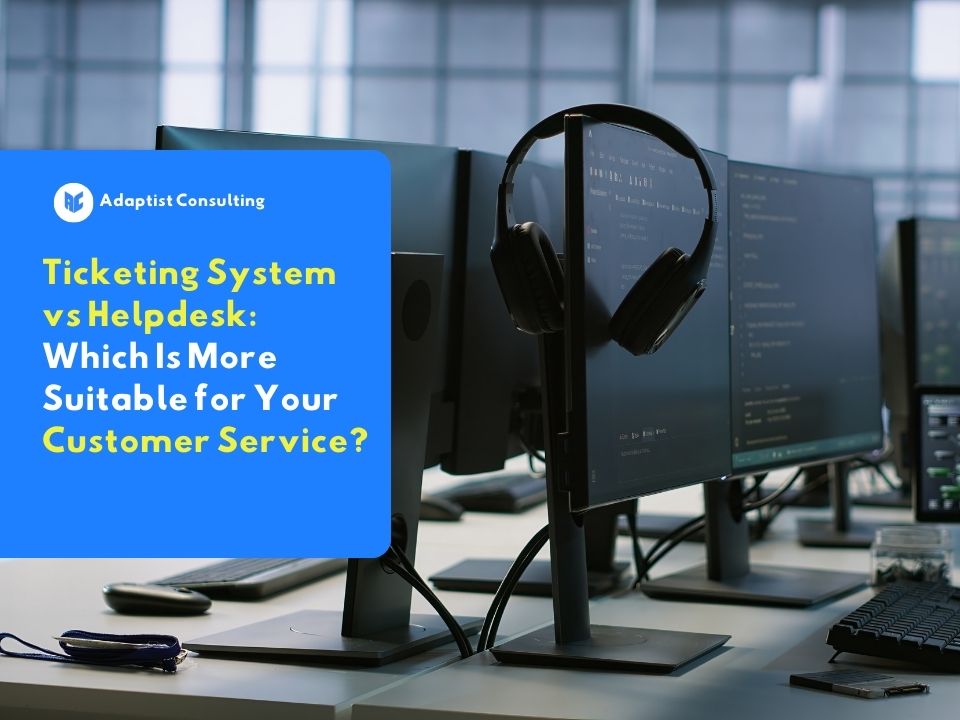
Ticketing System vs Helpdesk often becomes a topic of discussion when companies start taking customer service development more seriously. As customer expectations for fast responses and consistent solutions continue to rise, businesses can no longer rely on manual processes or fragmented communication.
In reality, many support teams believe they already have a helpdesk, when in fact they are using a ticketing system or vice versa. This lack of clarity can affect workflows, service quality, and overall customer satisfaction.
Therefore, understanding the difference between a ticketing system and a helpdesk is not merely about terminology. It is about how companies design customer support processes that are efficient, scalable, and aligned with long-term operational goals.
What Is a Ticketing System?
A Ticketing System is a system designed to record, organize, and track every customer request in the form of tickets. Each ticket represents a specific issue or request with a defined status, priority level, and assigned owner.
In enterprise environments, ticketing systems often serve as the operational foundation of customer support because they consolidate multiple communication channels such as email, website forms, live chat, and WhatsApp into a single centralized dashboard.
Key characteristics of a Ticketing System include:
- Every customer interaction is converted into a ticket
- Clear ticket status flow (Open, Pending, Resolved, Closed)
- Support for SLA management, prioritization, and auto-routing
- Integration with other systems such as CRM or knowledge bases
What Is a Helpdesk?
A Helpdesk is a service function or unit that aims to assist users or customers in resolving issues, whether technical or non-technical. A helpdesk may consist of a team, defined processes, or supporting software.
Unlike a Ticketing System, which focuses on ticket management, a Helpdesk emphasizes direct support and assistance activities. In many cases, helpdesks use ticketing systems as tools to support their operations.
Common characteristics of a Helpdesk include:
- A strong focus on service and communication
- Can be internal (IT helpdesk) or external (customer helpdesk)
- Emphasis on resolving day-to-day issues
- Does not always rely on advanced automation
Different between Ticketing System vs Helpdesk
In practice, the difference between a Ticketing System and a Helpdesk becomes more apparent when companies start handling a higher and more diverse volume of requests. At this stage, manual or semi-structured approaches often create bottlenecks, such as unhandled tickets, inconsistent responses, and difficulties in evaluating team performance.
According to TechRadar Pro, the following table compares ticketing systems and helpdesks across key aspects:
| Aspect | Ticketing System | Helpdesk |
|---|---|---|
| Primary focus | Ticket management, workflows, and status tracking | Support activities and issue resolution |
| Scalability | High, suitable for large ticket volumes and multi-channel support | Limited, dependent on agent count and manual processes |
| Automation | Supports auto-routing, SLAs, prioritization, and workflows | Generally limited automation |
| Reporting & analytics | Comprehensive and data-driven | Limited and often manual |
| Business suitability | Mid-sized to enterprise businesses | Small to mid-sized organizations |
Advantages and Disadvantages of Ticketing Systems vs Helpdesks
Each type of customer service solution comes with its own strengths and limitations. Ticketing Systems and Helpdesks address different needs, so their effectiveness depends heavily on the use case, organizational scale, and operational complexity.
Understanding the advantages and disadvantages of both options helps management make more strategic and realistic decisions, rather than simply following technology trends. Below are the advantages and disadvantages of Ticketing Systems and Helpdesks:
| Ticketing System | Helpdesk | |
|---|---|---|
| Advantages |
|
|
| Disadvantages |
|
|
Key Factors in Choosing a Ticketing System or Helpdesk
Choosing between a Ticketing System and a Helpdesk requires a more thoughtful approach than simply comparing features. This decision affects support team workflows, customer experience quality, and the company’s readiness for long-term growth.
For this reason, it is essential to evaluate business needs comprehensively before making a decision. The following key factors should be considered when choosing between a Ticketing System and a Helpdesk:
1. Volume and Complexity of Customer Requests
If your company receives a high volume of requests from multiple sources with varying urgency levels, a Ticketing System helps manage them in a structured way. If request volumes are still low and issues are relatively similar, a simple helpdesk solution may be sufficient.
2. Size and Structure of the Support Team
Large support teams divided into multiple functions (such as billing, technical support, and customer success) require systems that can automatically distribute tasks. Ticketing Systems support this through auto-routing, while Helpdesks are better suited for smaller teams with general roles.
3. SLA Targets and Service Standards
If the company operates under strict SLA commitments, a Ticketing System becomes essential because it tracks response and resolution times in real time. Helpdesks without system support often struggle to maintain consistent SLA performance.
4. Reporting and Performance Evaluation Needs
Organizations that rely on data-driven decision-making require accurate and measurable reports. Ticketing Systems provide metrics such as first response time, resolution time, and ticket backlog, whereas Helpdesks typically have limitations in this area.
5. Business Growth Plans
If a company plans to scale or increase its customer base, adopting a Ticketing System early can prevent the need for system migration later. Helpdesks are more suitable for short-term needs or simple operations.
When is a Ticketing System or Helpdesk Needed?
Ultimately, the decision to use a Ticketing System or a Helpdesk depends on operational context and business objectives. There is no universally right or wrong solution. What matters most is choosing a system that can consistently support customer service processes over time.
Many organizations start with a simple helpdesk and transition to a ticketing system as scale and complexity increase. This approach is reasonable, as long as decisions are made thoughtfully and based on real needs.
Use a Ticketing System if:
- Request volume is high and comes from multiple channels
- Clear SLAs and service standards are required
- The support team consists of multiple specialized roles
- Management needs data-driven insights
Use a Helpdesk if:
- The organization is small or focused on internal support
- Interactions are direct and not complex
- In-depth reporting is not yet required
- Budget and resources are limited
Conclusion
Ticketing System vs Helpdesk is not about choosing the most modern option, but about finding the solution that best fits business needs, processes, and growth direction. Ticketing Systems excel in structure, scalability, and data visibility, while Helpdesks are more effective for simpler and more personal service approaches.
For companies aiming to build consistent customer experiences and prepare for growth, combining Helpdesk functions with the right Ticketing System support is a smart move. With a strong system foundation, support teams can work more efficiently, respond faster, and align with company service standards.
If your business is considering adopting a Ticketing System or looking to improve the effectiveness of an existing Helpdesk, partnering with Adaptist Prose can be the first step toward building a more structured, efficient, and growth-oriented customer service operation.
FAQ
Yes. In practice, many companies use helpdesks as service functions while relying on ticketing systems as the primary tools to support helpdesk operations.
A business should start using a ticketing system when request volumes increase, communication channels expand, and consistent SLA tracking and reporting become necessary.
Without a ticketing system, businesses risk losing conversation history, struggling to monitor team performance, and experiencing inconsistent service as request volumes grow.