











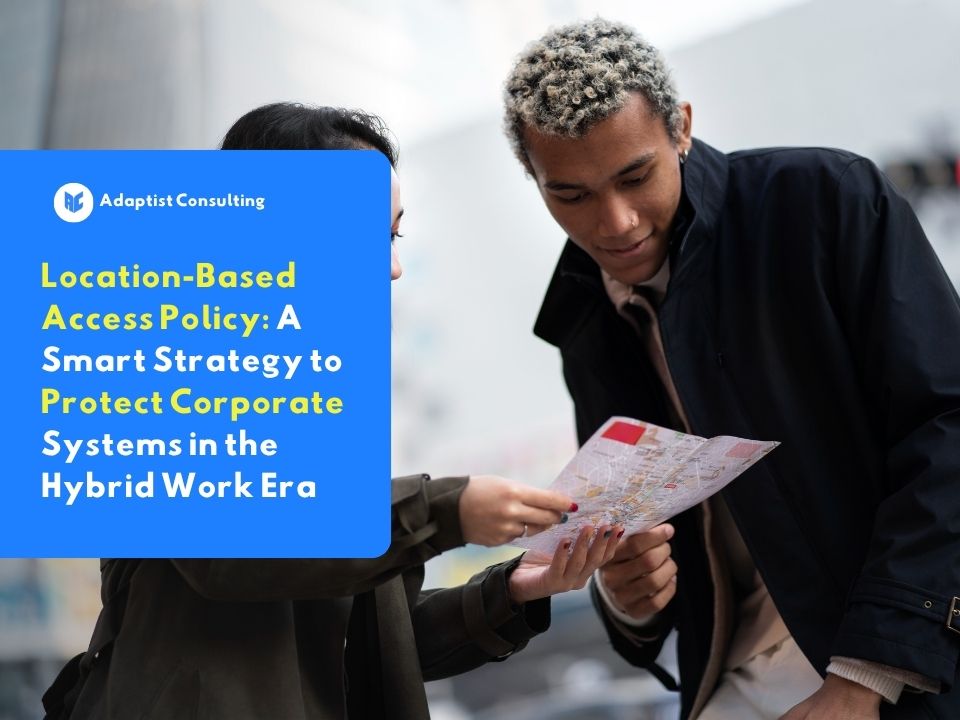
Location-based access policy has become one of the security layers that organizations can no longer afford to overlook, especially as employees work from different geographical points every single day.
Imagine someone accessing your system from an unknown country, outside work hours, with no one noticing until the damage is done.
What Is a Location-Based Access Policy?
A location-based access policy, or LBAP, is a security mechanism that restricts or grants access based on the user’s real-time geographical location. It evaluates location signals like IP addresses, GPS coordinates, or network data before deciding whether to allow access.
Why Does Location Become a Critical Factor in Access Security?
Every location carries a different risk context. Public network access at a coffee shop carries a far higher risk than access from an encrypted, IT-controlled office network.
Beyond network conditions, location also serves as a powerful anomaly signal. When the system detects logins from two cities within an impossible timeframe, it can immediately block access or trigger additional verification.
In the hybrid and remote work era, threats like these are increasingly real and difficult to detect manually. Without location controls, IT teams struggle to separate legitimate access from intrusions disguised as normal employee activity.
How Does This Policy Work in Practice?
Technically, a location-based access policy operates through several complementary mechanisms. Each mechanism handles different access scenarios based on what the organization requires.
Geofencing and IP Restriction
Geofencing is a technique that defines a virtual geographical boundary within which system access is permitted.
When a user attempts to access the system from outside the defined boundary, the system will automatically deny or hold the request until additional identity verification is successfully completed.
On the other hand, IP restriction works by creating a list of allowed (allowlist) or blocked (blocklist) IP addresses.
This approach is highly effective for work scenarios with relatively fixed access points, such as headquarters, branch offices, or specific client locations that have been previously registered.
Integration with IAM Systems and Zero Trust
A location-based access policy does not operate in isolation, but rather becomes one layer within the broader Identity and Access Management (IAM) ecosystem. By integrating location data into the IAM policy engine, every access request is evaluated contextually, not solely based on a username and password combination.
This approach differs from Role-Based Access Control, which only considers the user’s role when making access decisions. LBAP adds a location dimension as an additional, more dynamic verification layer.
This aligns with the Zero Trust principle of “never trust, always verify.” Location becomes one of the contextual factors that strengthens access decisions, alongside user identity, device condition, and access time recorded within the system.
Learn Zero Trust Security
Zero Trust Security is a security strategy that has become an urgent need for organizations amidst the high risk of cyber attacks and access abuse.
Zero Trust Security
Deepen your understanding of Zero Trust Security and learn its principles and implementation in depth by downloading this PDF. Your data security is our priority.
Implementation Examples Across Industries
LBAP is not exclusive to large tech companies. Organizations across many industries already apply it to meet their unique security needs.
- Banking and Finance
Financial institutions use this policy so only verified locations can access core banking systems.
The system automatically blocks access from high-risk countries without any manual intervention from the IT team. - Manufacturing
Manufacturers restrict access to SCADA (Supervisory Control and Data Acquisition, a centralized system that monitors and controls industrial production processes) and production data to the internal factory network or officially registered locations only.
This prevents potential operational sabotage that could directly impact the entire production chain. - Healthcare
Hospitals and clinics implement location policies to protect electronic patient medical records in accordance with applicable health data protection regulations.
Medical personnel can only access patient data from terminals inside the facility or from officially authorized networks. - Technology Companies
Remote developers can still access code repositories, but only through registered devices with active location verification running.
This combination ensures remote work flexibility is maintained without compromising the security of the company’s digital assets.
Challenges in Implementation and How to Address Them
Like any security policy, LBAP implementation also brings a number of technical and operational challenges that need to be anticipated.
Understanding these challenges from the outset will help organizations design policies that are more realistic and effective to execute.
| Challenge | Impact | Solution Approach |
|---|---|---|
| Users frequently change locations | Legitimate access repeatedly blocked | Combine with context-based step-up authentication |
| VPN complicates detection of actual location | Location policy vulnerable to bypass | Add device trust and endpoint verification layers |
| Policy configuration overhead | IT team administrative burden increases | Use a centralized policy management platform with rule automation |
| Cross-country regulatory compliance | Risk of data law violations | Map access policies according to applicable jurisdictions and local regulations |
Things to Consider Before Implementing This Policy
Before beginning to implement a location-based access policy, it is important to first conduct a comprehensive inventory of all digital assets and existing user access patterns.
Understanding where employees typically access the system will serve as the primary foundation for designing a policy that is not so strict it hinders productivity, yet strong enough to prevent unauthorized access.
In addition, coordination between IT, HR, and legal teams is essential to ensure that the policy is not only technically sound, but also compliant with applicable regulations, including Indonesia’s Personal Data Protection Law (UU PDP).
A phased pilot in one department before full rollout is highly recommended to identify gaps or operational obstacles early on.
Conclusion
A location-based access policy helps companies strengthen digital security without sacrificing the work flexibility modern teams expect. As threats grow more sophisticated and access points multiply, location is a context too critical to leave out of any access decision.
Adaptist Prime is an Identity and Access Management solution that helps companies implement location-based access policies in a centralized, structured manner, fully integrated with their existing digital security ecosystem.
Ready to Manage Digital Identities as a Business Security Strategy?
Request a demo today and discover how IAM solutions centralize user logins through Single Sign-On (SSO), automate employee onboarding, and protect company data from unauthorized access without disrupting productivity with repeated logins.
With contextual access control and compliance support for ISO 27001 and UU PDP, Adaptist Prime enforces strong security without disrupting daily workflows.
FAQ
Yes, by combining it with step-up authentication or Multi-Factor Authentication (MFA) so employees can still access the system after verifying their identity from a new location.
VPN can hide a user’s actual location, but a mature policy combines location verification with device trust and endpoint health checks, making a VPN bypass alone insufficient to gain full access.
Accuracy depends on the method used. IP-based detection tends to be less precise than GPS or specific Wi-Fi network methods, which is why many systems combine multiple location signals simultaneously for more accurate results.
Yes, as long as the IAM platform used supports real-time contextual evaluation on every incoming access request, this policy can run in both cloud and hybrid environments.
Not necessarily. Many modern IAM solutions can integrate location-based policies into existing systems without requiring large-scale infrastructure migration beforehand.