









Risk Mitigation: Definition, Objectives, Strategies, and How to Manage It
January 6, 2026
Audit Trail Real Time in Enterprise Governance
January 6, 2026Data Leakage: Definition, Causes, and Prevention
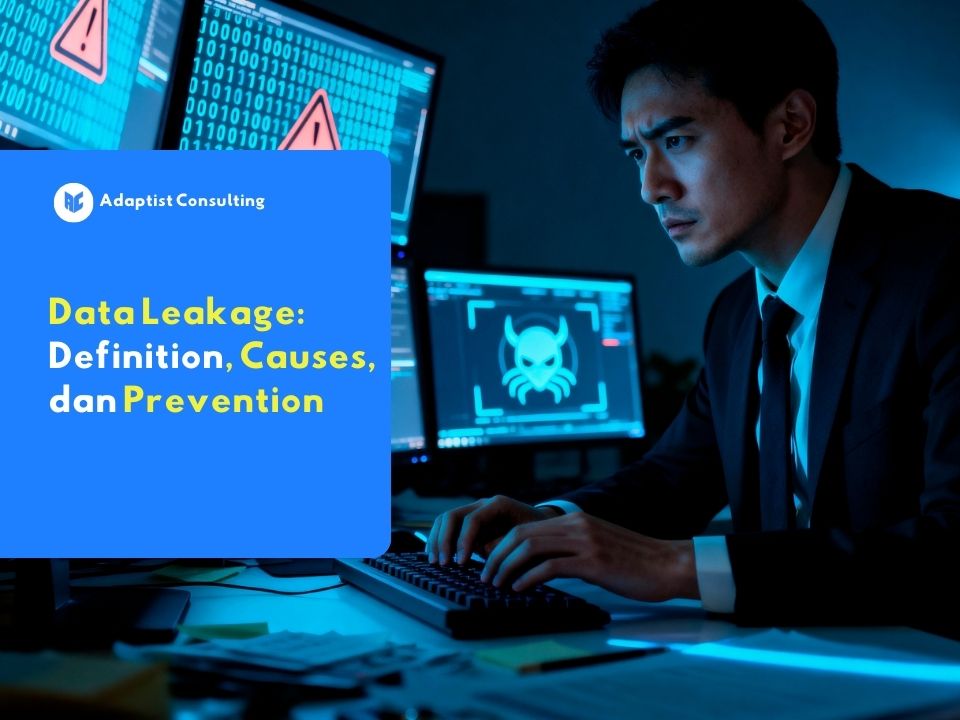
In today’s digital landscape, data has become the core of operational processes and the foundation for decision-making. However, the scalability of data management correlates directly with the complexity of the attack surface, where critical information is at risk of leaking, being transferred without authorization, or escaping from what should be a secure environment.
Data leakage incidents are often part of a gradual process that is difficult to spot occurring through process gaps, configuration fragilities, or internal threats before finally causing serious impact. For enterprise companies, conducting a thorough deconstruction of the mechanisms, channels, and triggers of data leakage is a critical foundation of effective cyber risk management.
What does data leakage mean?
Data leakage is the unauthorized outflow of sensitive data from an organization’s internal environment to external parties. This leakage can occur physically, such as through USB devices or printed documents, or digitally, for instance via email, cloud services, or unauthorized applications.
Unlike a data breach, which is generally caused by attacks from external parties, data leakage often originates from within the organization itself. Causes can range from system misconfigurations and user negligence (such as mistyping an email address) to inconsistent application of security policies.
Leaked data can include Personal Identifiable Information (PII), trade secrets, critical company documents, and even application source code. In many cases, these leaks do not happen suddenly but occur slowly due to weak access rights management, lack of data encryption, or the absence of a Data Loss Prevention (DLP) system.
Without adequate monitoring and audit trails, data leakage can persist for a long time undetected. Therefore, comprehensive visibility into data flow and user activity is a vital foundation in modern cybersecurity architecture, including the zero trust approach.
Learn Zero Trust Security
Zero Trust Security is a security strategy that has become an urgent need for organizations amidst the high risk of cyber attacks and access abuse.
Zero Trust Security
Deepen your understanding of Zero Trust Security and learn its principles and implementation in depth by downloading this PDF. Your data security is our priority.
Types of Data Leakage
This threat morphs into various forms that exploit specific gaps in IT infrastructure or employee work habits within an organization.
1. Shadow IT
Shadow IT refers to the use of software, applications, or cloud services by employees without the approval or knowledge of the IT department.
A potential case, for example, is a marketing employee downloading a customer lead database to a personal Google Drive account to access it from home and share it quickly with teammates, bypassing official corporate channels.
This action leaves customer data stored outside of corporate security controls. If that personal account is hacked or shared accidentally, the data is potentially compromised.
This phenomenon often arises because employees feel official corporate tools are inefficient for completing their tasks. They turn to public instant messaging apps or personal cloud storage to transfer company files. Although the goal is productivity, Shadow IT eliminates the security team’s visibility into data movement. When data resides on an unmanaged platform, you lose control over its encryption and access rights.
2. Privileged Access Abuse
The misuse of accounts with high-level access rights (privileged accounts) is one of the most dangerous sources of data leakage.
Administrator or senior manager accounts often have unlimited access to sensitive company data. If these accounts are compromised by hackers or used recklessly by non-owners, the impact can be severe.
Many companies fail to apply the Least Privilege principle, granting excessive access to users who don’t actually need it. Managing this requires strict Centralized Access Management for Enterprise Security solutions to limit unnecessary latitude.
3. Legacy Tools
Relying on software that has reached its end-of-life (support period ended) is an open invitation for data leakage.
Legacy systems often have security vulnerabilities that are publicly known but no longer receive patches from developers. Hackers can easily exploit these gaps to extract data from old databases. Furthermore, tools with outdated security systems are often incompatible with modern security protocols like MFA or advanced encryption.
4. Phishing
Phishing attacks manipulate human psychology to deceive or manipulate employees into handing over login credentials or downloading malware.
These techniques are becoming increasingly sophisticated, shifting from generic mass emails to spear-phishing—highly targeted attacks aimed at executives or finance teams. Once hackers obtain legitimate credentials, they can access and exfiltrate data as if they were official employees of the company.
Data leakage resulting from phishing is very difficult to detect by traditional firewalls because the traffic appears valid. Read also: What is SSO (Single-Sign-On)? How Secure is it for Business?
Baca juga : What is SSO (Single Sign-On)? How Safe is it for Businesses?
5. Web & Email Exfiltration
Exfiltration (unauthorized data transfer) via web and email occurs when data is sent out through official communication channels but to the wrong destination.
A simple example is an employee accidentally sending an attachment containing payroll data to an external email address that looks similar to an internal one—for instance, sending it to hr@company-co.com instead of hr@company.co.id. Or, the use of automated scripts on a website that unknowingly exposes a customer database to the public internet.
Threats Posed by Data Leakage
Data leakage is not just a technical incident; it is a strategic crisis with cascading impacts that damage the organization’s foundation in financial, legal, operational, and reputational aspects. The impact is often cumulative and permanent, eroding corporate value and stakeholder trust from within.
1. Financial Loss
Data leakage incurs costs that are often far greater than estimated. Direct costs include forensic investigations, system recovery, customer notifications, credit monitoring services, and regulatory fines.
Additionally, there are hidden costs such as operational downtime, revenue loss, increased cyber insurance premiums, and IT security reinforcement. In fact, the loss of customer trust can make the cost of acquiring new customers 5 to 25 times more expensive.
2. Reputational Damage
Trust is very important in B2B business. One data leak can destroy the trust you have built for years.
Clients and business partners will question your ability to keep their corporate secrets safe. In the long run, this stigma of insecurity can lead to customer loss (churn) and difficulty winning new contracts due to a tarnished reputation.
3. Continued Security Threats
Leaked data is often reused by hackers as a roadmap for larger subsequent attacks.
Information such as organizational charts, email addresses, or leaked password hashes can be sold on the dark web. Other hackers then use this data to launch brute force attacks or more precise social engineering campaigns against your corporate infrastructure.
4. Legal and Compliance Issues
In an era of strict privacy regulations, compliance is mandatory.
In Indonesia, non-compliance with data protection can lead to severe sanctions under the UU PDP (Personal Data Protection Law). Ensuring your organization has a GRC System for mandatory UU PDP compliance in Indonesia is a critical step to avoid administrative fines and even corporate criminal liability.
5. Operational Disruption
Post-incident investigations will consume the time and resources of IT, legal, and management teams.
The company’s focus will be split between handling the crisis and running the core business. This disruption often causes delays in strategic projects and an overall decline in employee productivity.
Common Causes of Data Leakage
Understanding the root causes is the first step in designing an effective defense strategy.
1. Human Error
Statistics consistently show that human error is the leading cause of data leakage. Based on data obtained by Egress Software Technologies via Freedom of Information (FOI) requests, nearly two-thirds (62%) of data leakage incidents reported to the UK Information Commissioner’s Office (ICO) were caused by human error—far exceeding other causes like insecure webpages and hacking, which combined only contributed 9%.
Human error can take the form of server misconfiguration, loss due to theft of unencrypted work devices (laptops/phones), or misdelivery of emails. Fatigue and lack of meticulousness are often the main triggering factors in fast-paced work environments.
2. Insider Threat
Insider threats stem from active employees, former employees, or contractors who have legitimate access to company systems and data but abuse those access rights. This abuse is often difficult to detect because the perpetrator operates from within a trusted environment.
Motivations vary, ranging from financial gain and revenge to industrial espionage.
3. Poor System Configuration
Complex cloud infrastructure often leads to security misconfigurations.
IT teams might forget to close specific ports or leave default passwords on new devices. These small gaps are enough for automated hacker bots to find and extract sensitive data from your company.
4. Weak Encryption
Data stored (data at rest) or transmitted (data in transit) without strong encryption becomes an easy target for hackers.
If a device is stolen or a network is intercepted, unencrypted data can be instantly read and exploited. Many companies that do not fully grasp the risks still ignore encryption at the internal database level due to performance concerns, even though this is the last line of defense.
How to Prevent Data Leakage Effectively
Preventing data leakage requires a paradigm shift from simply installing antivirus software to implementing comprehensive information governance. Here are strategic steps that must be taken by IT management and corporate security.
1. Data Classification and Mapping
You cannot protect what you do not know. The fundamental step in leakage prevention is mapping where data flows and classifying it based on sensitivity levels.
Without clear classification labels, security policies will be generic and ineffective. This strategy must include recording the purpose of processing and identifying who has access to the assets.
For enterprise scale, doing this manually using spreadsheets is highly prone to error. Using automation systems for Record of Processing Activities (ROPA) ensures this mapping is always accurate and up-to-date.
2. Implementing Least Privilege and Access Control
Grant access only to those who truly need it to complete their work, and nothing more. The Least Privilege principle limits an intruder’s latitude if employee credentials are successfully stolen.
The biggest problems often arise in User Lifecycle Management, especially when employees leave or transfer divisions. Accounts left active (orphan accounts) are a favorite loophole for insider threats.
Modern organizations need to switch to centralized identity management. With this mechanism, the access revocation process (de-provisioning) can be done in minutes, not days, instantly closing data exfiltration gaps.
3. Encryption and Strong Authentication (MFA)
Data must be protected both at rest and in transit. However, encryption alone is not enough if access keys are easily stolen.
Mandate the use of Multi-Factor Authentication (MFA) for all access to critical systems. MFA acts as a final fortress; even if a password leaks, hackers cannot enter without the second verification factor.
Implementation of this security policy must be consistent across all applications. Using a Single Sign-On (SSO) solution can simplify this policy application while simultaneously enhancing user convenience.
4. Third-Party Risk Management (Vendor Risk)
Data leakage often happens not in your system, but through vendors or business partners who have access to your data.
Conduct regular security audits on all third-party service providers. You must ensure they comply with privacy standards as strict as your company’s through a Third Party Risk Assessment (TPRA).
Ensure cooperation contracts include clauses regarding incident reporting obligations and clear data protection standards.
5. Education and Security Culture
Even the most advanced technology will fail if the human factor is ignored. Security awareness must be built through relevant and continuous training.
Train employees to recognize signs of phishing, the dangers of using public Wi-Fi, and incident reporting procedures. When every employee realizes they are a data gatekeeper, the risk of human negligence can be significantly suppressed.
Conclusion
Data leakage is often not about sophisticated hackers penetrating your firewall, but about backdoors inadvertently left open by insiders.
Understanding the nuanced difference between data leakage and data breach is the first step, but real action is far more crucial. Organizations can no longer rely on traditional perimeter security in an era of hybrid work and massive cloud adoption.
Ready to Manage Digital Identities as a Business Security Strategy?
Request a demo today and discover how IAM solutions centralize user logins through Single Sign-On (SSO), automate employee onboarding, and protect company data from unauthorized access without disrupting productivity with repeated logins.
The key to successfully mitigating this risk lies in the integration of strict access control technology and a risk-aware compliance culture. With the right tools like Adaptist Prime for your identity management, you can transform vulnerabilities into operational resilience.
Start auditing your organization’s data flows and access rights today.
FAQ
The biggest risk is data exfiltration in the final minutes and accounts that remain active after the employee leaves (zombie accounts). Often, employees copy client databases or intellectual property to personal storage before their access is revoked. To address this, the offboarding process must be instant and automated. The User Lifecycle Management feature in Adaptist Prime ensures access rights are revoked in real-time across all applications as soon as employment status changes, cutting time from days to minutes
Total prohibition often drives employees to find other, more dangerous paths. The best solution is to provide secure corporate alternatives that are equally user-friendly. Additionally, implement Single Sign-On (SSO) for all allowed applications. With SSO, the IT team has full visibility into who accesses applications and when, and can cut off that access in a single click if anomalies are detected.
The IT community often discusses that DLP without a strategy is merely a noise generator. DLP is only effective if you already have mature Data Classification. If you don’t know which data is Confidential and which is Public, the DLP system cannot work accurately.
Data Leakage is unauthorized data transmission—often from inside to outside—that can occur without a cyberattack (e.g., mis-sent email or upload to a public cloud). Conversely, a Data Breach usually refers to an incident where external hackers successfully penetrate defenses and steal data. Simply put, leakage is often the initial cause that facilitates a large-scale breach.