








Over the past decade, the way businesses operate has fundamentally changed. Companies no longer rely on one or two core systems, but rather on an ecosystem of interconnected digital applications.
Email, financial systems, HRIS, CRM, collaboration applications, to various specialized SaaS are now part of employees’ daily activities.
The problem is, each system typically comes with one account and one password. As the number of applications increases, access management complexity soars.
Employees have to remember many account credential pieces of information, while IT teams have to manage hundreds to thousands of accounts with constantly changing lifecycles.
The impact is not only technical but is directly felt by the business:
- Productive work time is wasted due to login problems
- Security risks increase due to weak or reused passwords
- Onboarding and offboarding processes become slow and error-prone
- Access control becomes non-transparent for management
It is in this context that SSO (Single Sign-On) often emerges as a solution. SSO allows for just one login to access all necessary applications.
However, critical questions arise:
- Is SSO truly safe for businesses?
- Does SSO actually add risk if a data breach occurs?
What is SSO (Single Sign-On)?
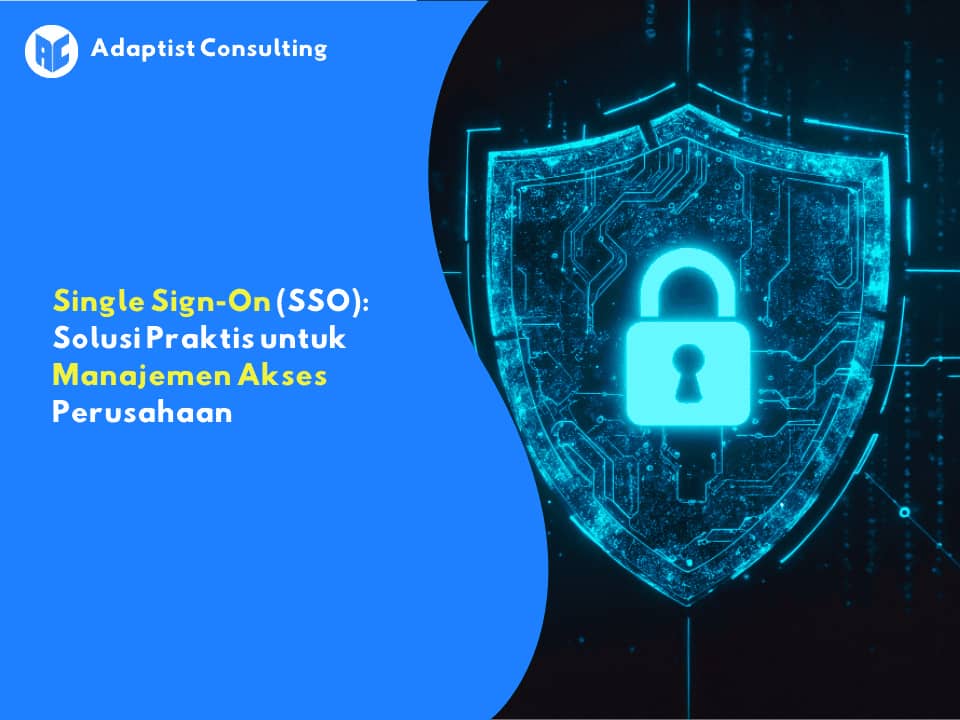
Single Sign-On (SSO) is a centralized authentication system that allows users to access various business applications or systems with a single login process.
Once users successfully authenticate, the system recognizes them as they move between applications, without requiring repeated logins.
Put simply, SSO acts as a single gateway for employees. It functions as a control point that determines who can access which systems, when, and under what conditions.
For example, imagine SSO as a receptionist or a single access card system in your office building. Once your employees are verified at the main lobby (using a fingerprint scan or access card), they can enter meeting rooms, pantries, server rooms, and workspaces without having to re-verify their identity.
SSO works the same way in the digital world: after logging in once, access to Salesforce, Google Workspace, Microsoft 365, Asana, Zoom, and HR systems is automatically and securely granted.
Remember! SSO is not merely a technical feature that makes it easier for employees. It is a strategic tool for centralized access management and control.
For companies, SSO enables centralized management of access across the entire application ecosystem. For employees, it delivers a smoother work experience, free from constant authentication interruptions. Efficient, isn’t it?
Benefits of SSO
The primary benefit of SSO is making authentication “more convenient.” However, when examined more deeply, its impact on efficiency, cost, and business risk is substantial.
1. Improved User Convenience
SSO simplifies the work experience by eliminating repetitive login processes. Convenience matters because employee behavior is heavily influenced by system usability.
If you have ever heard employees complain about login issues, or seen frequent IT tickets for password resets, it may be time to consider implementing SSO.
2. Significant Productivity Increase
Time is the most irreplaceable business asset. Without SSO, precious minutes are wasted daily on repeated login processes, password recovery, and switching between applications.
Imagine each employee saving just 5 minutes per day. In a company with 200 employees, that translates into 500 hours of time saved every month.
With SSO, this time can be redirected toward higher-value activities such as serving customers, completing analysis, or driving innovation.
3. Reduced IT Team Burden
When IT teams are constantly flooded with “forgot password” tickets, they are prevented from working on more strategic initiatives.
With centralized access through SSO, the need for manual password resets and account management decreases significantly.
As a result, your IT specialists can refocus on optimizing infrastructure, developing solutions, and accelerating business digitalization. You not only save costs but also allocate human resources better.
4. Better Compliance and Auditing
For Compliance and Risk Managers, SSO is a game-changing oversight tool. It provides centralized and unified audit logs that record every login activity, accessed application, and access timestamp.
If an incident occurs or an external audit is required (e.g., for PDPI, ISO 27001, or SOC 2 compliance), you can quickly answer critical questions: “Who accessed this data?” and “When?”
This capability not only satisfies regulatory requirements but also proactively strengthens data governance across the organization.
5. Improved Account Security
In many cases, the biggest security risk does not come from system failure, but from human behavior. According to Heydata.eu, about 95% of security incidents are caused by human error, such as clicking phishing links or using weak and repeated passwords.
This is where SSO becomes relevant. By reducing the number of accounts and passwords that employees have to manage, SSO directly reduces the likelihood for human error.
Instead of securing many scattered login points, companies can centralize login access in one system. This way, security controls are more consistent, easier to monitor, and easier to strengthen.
6. Cleaner Onboarding & Offboarding Control
SSO simplifies employee lifecycle management. With SSO, you can easily grant and revoke login access to all applications quickly and easily.
This reduces the risk of orphaned accounts and ensures that employee status changes do not leave security gaps behind.
7. Easy Integration
In a growing business, new applications and systems will continue to be adopted. Fortunately, modern SSO solutions are designed with broad compatibility using industry standards (such as SAML and OIDC), enabling relatively fast and easy integration with thousands of cloud and on-premise applications.
This means, if the company adds a new system in the future, you do not need to deal with heavy administrative burdens.
SSO provides a scalable foundation for the company’s digital ecosystem, supporting growth and innovation without adding uncontrolled access complexity.
How SSO Works
Conceptually, the SSO workflow is quite simple:
- Access Requested: An employee tries to open a business application (example: Salesforce).
- Redirected to SSO Portal: The application recognizes that the company uses SSO, then redirects the employee to the company’s centralized login portal (e.g., login.yourcompany.com).
- Single Verification: The employee enters their main credentials (e.g., company username + password + mobile verification).
- Centralized Permission Granting: Once verified, the SSO system issues a secure “electronic ticket” to Salesforce, confirming: “This user is authenticated and authorized to access the system.”
- Access Granted: The employee is logged into Salesforce, and the same process automatically applies when accessing Workday, Slack, or other integrated applications.
In essence, employees only need to verify their identity once. After that, the system will permit access to the various applications used by the company.
Is SSO Secure?
This question is very relevant and cannot be answered in black and white. From a business perspective, the correct answer is: SSO is safe if managed properly.
Like any security technology, SSO carries inherent risks. The main risk is when user credentials are successfully compromised.
In such cases, all applications connected to SSO could potentially be accessed by an attacker, since access is centralized under a single identity.
However, this risk can be fully mitigated with the following practices:
- Mandatory implementation of Multi-Factor Authentication (MFA) on SSO login. MFA is a critical defense layer. Even if a password leaks, the attacker still cannot log in without the second factor (phone, biometrics).
- Using strong passwords for main login credentials.
- Company-wide security awareness training to reduce phishing risks.
Integrating SSO with IAM for Greater Security
SSO is a strong foundation, but to build truly robust security and governance, it must be integrated into a comprehensive Identity and Access Management (IAM) framework.
IAM is a framework that ensures digital identities are managed consistently, securely, and in alignment with business policies.
Ready to Manage Digital Identities as a Business Security Strategy?
Request a demo today and discover how IAM solutions centralize user logins through Single Sign-On (SSO), automate employee onboarding, and protect company data from unauthorized access without disrupting productivity with repeated logins.
If SSO answers “How does a user log in?” (Authentication), then IAM answers the more critical business questions: “What is the user allowed to access and do after login?” (Authorization) and “How do we manage and audit it?” (Governance).
In other words, SSO is an efficient main entrance, while IAM is the complete security system, operational rules, and audit logs across the entire company system.
This integration provides three strategic advantages:
- Precise and Automated Access Control (RBAC). IAM enables granting access based on roles, positions, or divisions (Role-Based Access Control). When an employee is promoted or moves divisions, their access to all applications can be adjusted automatically. This eliminates manual errors and the principle of least privilege (only grant necessary access) is achieved consistently.
- Layered and Contextual Security. Modern IAM systems strengthen SSO with adaptive Multi-Factor Authentication (MFA). If a login attempt is detected from an unfamiliar location or device, the system can automatically request additional verification (e.g., using a phone number or fingerprint). This adds intelligent security without disrupting the routine user experience.
- Strong Audit and Compliance. For Compliance & Risk Managers, this integration is a essential. You can quickly generate reports such as: “Who has access to financial data?” or “Have all former employees’ accesses been fully revoked?” This centralized audit capability is crucial for meeting regulations such as PDPI, GDPR, or ISO 27001 standards.
If you want to integrate SSO, you can use Adaptist Prime. Adaptist Prime allows you to manage SSO, perform audits and compliance, and enhance security in layers within one platform easily.
Conclusion: Ready to Implement SSO?
SSO (Single Sign-On) is a foundational component of modern digital business transformation. It simplifies access, increases productivity, and reduces operational overhead. However, SSO is not a standalone security solution.
Without proper controls, SSO can actually increase risk. Therefore, a mature approach is to see SSO as a business enabler, not just a technical feature.
For CEOs, CIOs, and business owners, the decision to adopt SSO must be accompanied by strategic questions: how is digital access managed securely, measurably, and in line with business goals?
By integrating SSO into a robust IAM system, organizations can achieve the right balance between convenience, security, and control.
This is the key to building digital operations that are both efficient and resilient amid increasing business complexity.
Adaptist Prime helps executives & IT teams design and manage IAM strategies that align with business goals. Consult with our specialists regarding your specific challenges to build an identity security framework that not only protects but also empowers the growth of your organization.
FAQ
SSO is a centralized authentication system that allows users to access all enterprise applications with just one login. It is like having a single “master” access card to enter every room in an office building without needing different keys for each door.
The risk exists (single point of failure), but SSO is actually more secure when combined with MFA (Multi-Factor Authentication). MFA acts as an absolute defense, preventing hackers from entering even if they have the password, making it stronger than managing many weak, scattered passwords.
SSO eliminates time wasted on repeated logins and “forgot password” issues. Research shows this can save hundreds of work hours per month (for a company of 200 employees) and drastically reduce the burden of IT helpdesk tickets for password resets.
SSO answers “How do I get in?” (Authentication), while IAM answers “What am I allowed to access once inside?” (Authorization & Governance). SSO is the gateway, while IAM is the comprehensive rule and monitoring system within.
SSO provides a centralized audit log that records who accessed what and when in real-time. This makes it easy for companies to answer critical audit questions and comply with standards like ISO 27001 or data privacy regulations without checking each application individually.