










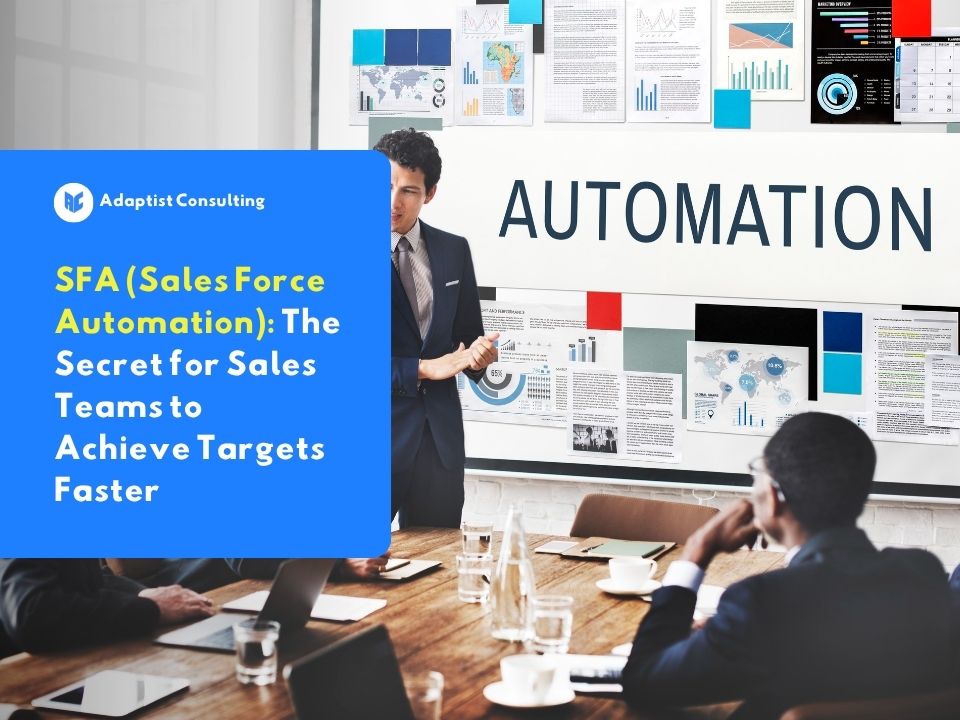
SFA (Sales Force Automation) has become an absolute foundation for business digital transformation initiatives that demand high operational speed and accuracy. This advanced system is here to save sales teams from daily administrative burdens that often waste productive time.
Losing focus on strategic pitching activities will directly threaten the company’s conversion rates. Therefore, adopting smart technology is highly needed to take over all these repetitive tasks automatically.
What Is SFA (Sales Force Automation)?
SFA stands for Sales Force Automation which has evolved into a crucial pillar in modern business management. This system is designed to automate business processes and can be integrated with identity and access management (IAM) systems to ensure secure login access for sales staff.
Its main goal is to free salespeople from tedious and time-consuming clerical tasks. Staff no longer need to waste energy on manual data entry which is highly prone to typos.
The collected data is then processed systematically and secured through advanced data decryption methods to provide a comprehensive view of each transaction status.
How SFA Works in Modern Business
The system begins by capturing prospect data from various integrated sources like website forms or social media campaigns.
This raw information is then centralized into a secure database that the entire sales team can access. Once the data is stored, the software applies predefined rules to qualify leads and track their journey.
The platform continuously updates the transaction status in real time until the deal is successfully closed.
Essential Features in SFA Systems
A reliable sales automation system is certainly equipped with a range of crucial technical abilities. Here are several essential features that must exist in enterprise-level SFA software.
Sales Pipeline Management
This feature serves to provide clear visualization of each prospect’s position within the company’s sales funnel. Users can monitor the movement of potential clients from the initial contact stage to the transaction closing process.
For example, sales managers can directly see how many prospects are currently in the proposal submission or price negotiation stage. Such systematic visualization makes it very easy for the team to identify bottlenecks so that delayed transactions can be resolved immediately.
Activity and Contact Tracking
Remembering every detail of client communication manually is an impossible task for workers to do. The contact tracking feature is here to record the entire history of calls, email exchanges, and important meeting notes.
The main concept is to conduct a comprehensive digital customer profiling process for every client entity interacting with the business. The security of this client contact database must also be protected from potential insider threats so it is not misused by unauthorized parties.
Sales Reporting and Analytics
The reporting feature within the system presents data-driven insights to evaluate the daily effectiveness of team performance. SFA systems can generate comprehensive report documents instantly without requiring staff to wait for conventional calculations.
Its application is clearly seen from interactive dashboards displaying graphical metrics of monthly target achievements for each salesperson. Division leaders can securely use these analytical matrices through access restrictions based on SSO (Single Sign-On) protocols to design new promotional strategies.
Repetitive Task Automation
The core strength of SFA technology lies in its ability to consistently automate routine workflows. This smart system can be set up to send follow-up email messages to clients automatically.
This automation concept can also be applied to creating reminder schedules to call back potential prospects who have not responded. Salespeople no longer need to set manual reminder alarms because the system will directly provide automatic notifications on the monitor screen.
Tasks That Can Be Automated with SFA
Modern automation technology excels at handling repetitive daily administrative duties. Here are several specific tasks that this smart system can execute automatically for your team.
- Data Entry: Automatically logging call durations and email interactions into the prospect’s profile.
- Lead Distribution: Routing new incoming prospects to the most appropriate sales agent based on territory or expertise.
- Follow-Up Reminders: Triggering system notifications for agents to contact leads who have gone cold.
- Quote Generation: Creating accurate pricing proposals based on pre-configured product catalogs and discounts.
Main Benefits of SFA Implementation for Business Growth
Shifting from conventional recording methods to digital automation systems is proven to bring massive positive impacts. There are various high-value strategic advantages that companies can immediately feel after the implementation process.
- Boosting Team Productivity: Salespeople can close more deals as they are free from administrative operational burdens.
- Revenue Forecasting Accuracy: Executive management can make sharper business forecasts thanks to the availability of integrated data insights.
- Interdepartmental Collaboration: All internal divisions can view the same single source of truth to support the smooth synchronization of regulatory audits and enterprise GRC systems.
- Shortening Sales Cycles: The approval process for client document submissions can run much faster through automated workflows.
- Increasing Conversion Rates: Fast service responses guided by SFA systems make every potential customer feel highly valued.
Differences Between SFA and CRM (Customer Relationship Management)
Many business practitioners sometimes still equate the technical concept of SFA with CRM (Customer Relationship Management) systems. Both systems have different functional focuses even though they complement each other within the enterprise ecosystem.
| Comparison Criteria | SFA (Sales Force Automation) | CRM (Customer Relationship Management) |
|---|---|---|
| Operational Focus | Optimizing the new client acquisition flow and the sales closing process. | Building strong loyalty and managing retention programs for existing customers. |
| Dominant Users | Sales managers and the frontline agents in the field. | Customer service staff and technical teams managing IT Support Software. |
| Ultimate Goal | Increasing team workflow efficiency to drive revenue achievement. | Creating superior customer experiences to consistently maintain long-term satisfaction. |
For a clear SFA use case, a sales representative uses it to track cold emails and schedule follow-up calls with new leads.
Conversely, a CRM use case involves a support agent using the system to view a loyal customer’s purchase history while resolving a technical ticket.
Conclusion
Relying on manual recording processes in a fiercely competitive business era is clearly a step backward. Modern companies are highly required to quickly adapt to the presence of automation technology to dominate the market share.
SFA has proven to be a crucial instrument in shaping agile and result-oriented salespeople. Investing in this smart software will pay off entirely through a surge in sustainable business profit margins.
Adaptist Consulting understands the complex challenges companies face in managing their sales team operations effectively. We present a comprehensive solution with Adaptist Prose designed specifically to transform the way a team works.
Optimize Your Customer Service
Schedule a demo of Adaptist Prose and see how an integrated ticketing system helps bring tickets, conversations, and customer data together in a single dashboard. With a more structured workflow, teams can respond faster, reduce operational burden, and maintain consistent service quality as the business grows.
The Adaptist Prose innovation is equipped with various high-level automation capabilities to streamline the entire business process.
FAQ
Yes, this technology is highly flexible and scalable for small to medium enterprises. Early implementation helps build a neat operational foundation before expanding.
Implementation duration depends on organizational complexity and data migration volume. Typically, the transition takes anywhere from a few weeks to a few months.
No, the system strictly acts as a technical tool to support daily productivity. Personal human communication remains the most vital factor in building trust with clients.
Management can track key metrics like shortened sales cycles or increased transaction closing rates. Another clear success indicator is a reduction in staff complaints regarding daily administrative tasks.
Most modern platform vendors design products with open interfaces to facilitate digital integration. The software can be practically connected to company email systems or accounting services.