










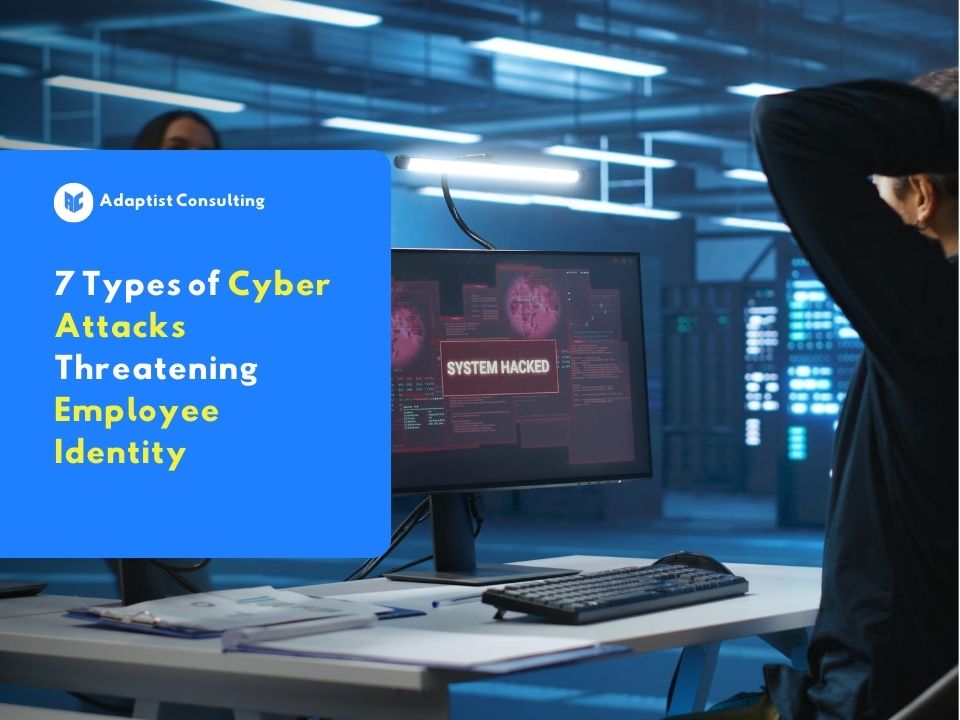
Cyber attacks targeting employee identities have become one of the most serious threats faced by companies across industries.
When an employee’s credentials are compromised, threat actors can move freely within the internal network without being detected.
The IBM Cost of a Data Breach Report 2025 found that phishing is the most common initial attack vector, involved in 16% of all data breach incidents studied, with an average loss of USD 4.88 million per incident.
This makes employee identity the most valuable yet most vulnerable asset in a company’s cybersecurity ecosystem.
These threats do not only come from outside the organization, but can also emerge from within.
Understanding the types of attacks that specifically target employee identities is the first step toward building an effective defense.
1. Phishing (Cyber Attack Through Convincing Fake Emails)
Phishing is an attack technique where perpetrators send fraudulent communications, typically via email, designed to resemble official messages from trusted entities such as banks, vendors, or even internal management.
The goal is to trick employees into revealing login credentials, clicking malicious links, or downloading malware-laden attachments.
A common scenario: an employee receives a seemingly official email from the “IT division” asking them to update their password through a specific link.
Without further verification, the employee unknowingly hands over their account access directly to the attacker.
The Difference Between Spear Phishing and Regular Phishing
To better understand the distinction between the two, here is a comparison between regular phishing and spear phishing that every employee should be aware of.
| Aspect | Regular Phishing | Spear Phishing |
|---|---|---|
| Target | Mass, non-specific | Specific individual or organization |
| Personalization | Low (generic messages) | High (uses real names, positions, or context) |
| Threat Level | Moderate | Very High |
| Example | Fake promo email from a “bank” | Fake email impersonating the employee’s direct supervisor |
2. Credential Stuffing (Cyber Attack Exploiting Leaked Data)
Credential stuffing leverages credential data that has been leaked from previous security breaches, then automatically tries them across hundreds of digital services at once.
This attack is effective because many employees still use the same email and password combination across multiple platforms.
When a data breach occurs on one platform, all other accounts belonging to that employee are also at risk.
Here are signs that an employee’s account may be affected by credential stuffing:
- Login notifications from unknown locations or devices.
- Account suddenly locked without any apparent reason.
- Suspicious activity in internal system access history.
- Unauthorized changes to account settings.
3. Man-in-the-Middle (Silent Cyber Eavesdropping Attack)
A Man-in-the-Middle attack occurs when an attacker secretly positions themselves between two communicating parties, for example between an employee and the company’s application server.
All transmitted data, including login credentials and sensitive information, can be intercepted and manipulated without either party’s knowledge.
Imagine an employee working from a café and connecting to an unencrypted public Wi-Fi. An attacker on the same network can intercept all of that employee’s communications in real-time, including login sessions to company applications.
Situations Vulnerable to MitM
- Using public Wi-Fi networks without a VPN (cafés, airports, hotels).
- Connecting to websites that do not use the HTTPS protocol.
- Devices connected to a rogue access point (Evil Twin Attack).
- Using outdated applications that do not encrypt their data transmission.
4. Social Engineering (Psychological Manipulation of Employees)
Social engineering is an attack that exploits the human factor rather than technical system vulnerabilities.
Perpetrators leverage trust, a sense of urgency, or perceived authority to manipulate victims into voluntarily providing access or sensitive information.
For example, an attacker calls a finance employee while posing as the CEO, urgently requesting an immediate fund transfer for an emergency contract, a tactic commonly known as Business Email Compromise (BEC).
This is why cyber attacks based on social engineering are often considered the most dangerous threat, because no advanced security system can override human decisions made under emotional manipulation.
Employees at all levels, including senior executives, are vulnerable to these attacks.
Common Forms of Social Engineering
- Pretexting: The attacker creates a false scenario to gain the victim’s trust, such as posing as an IT auditor who needs account access for an urgent audit.
- Baiting: The victim is lured with something enticing, like a flash drive labeled “bonus” left in the office area, which actually contains malware.
- Vishing (Voice Phishing): An attack via phone call where the perpetrator impersonates an authority figure, such as an IT helpdesk or bank official, to directly request credentials.
- Tailgating: The perpetrator physically follows an authorized employee to enter a restricted area without passing through the security system.
5. Brute Force Attack (Cyber Attack That Cracks Passwords Systematically)
A brute force attack is a method where attackers use automated software to systematically try thousands to millions of password combinations until they find the correct one.
This attack is highly effective against accounts with weak or easily guessable passwords.
To protect employee identities from this attack, apply the following measures:
- Require passwords with a minimum length of 12 characters, combining uppercase and lowercase letters, numbers, and symbols
- Enable account lockout policies after several failed login attempts
- Implement Multi-Factor Authentication (MFA) across all company accounts
- Prohibit the use of easily guessable passwords such as names, dates of birth, or keyboard patterns
6. Insider Threat (The Danger From Within the Organization)
Insider threat refers to security risks originating from individuals who have legitimate access to company systems, such as active employees, former employees, contractors, or business partners.
These threats fall into two categories, namely malicious insiders who deliberately abuse their access, and unintentional insiders who without any ill intent become a weak point due to negligence or lack of security awareness.
Both are equally dangerous. Unintentional insiders often cause larger incidents because no detection system is specifically designed to recognize unintentional human error.
Behavioral Indicators to Watch Out For
- Accessing data or systems outside the scope of their job responsibilities.
- Login activity at unusual hours, such as midnight or public holidays.
- Abnormally high volumes of downloads or data transfers in a short period.
- Attempts to access systems after a contract or employment period has ended.
- Use of external storage devices without authorization from the IT team.
7. Identity Spoofing (Impersonating Another Employee)
Identity spoofing is an attack where the perpetrator falsifies an employee’s digital identity, whether through email address forgery (email spoofing), document metadata manipulation, or the use of stolen credentials, to carry out unauthorized actions on behalf of that employee.
This attack is particularly dangerous because its digital footprint appears to point to the employee whose identity was stolen.
The impact of identity spoofing on a company can be far-reaching and damaging, including:
- Unauthorized financial transactions authorized under the employee’s name.
- Leakage of confidential company data sent to external parties.
- Reputational damage to the employee whose identity was misused.
- Operational disruption caused by actions carried out using a fake identity.
- Potential legal sanctions if the falsified identity is used for illegal activities.
Conclusion
The seven types of cyber attacks above prove that threats to employee identity are multidimensional, coming from multiple directions, using diverse techniques, and targeting both technological vulnerabilities and human weaknesses.
Companies that neglect the security of their employees’ identities face not only the risk of data breaches, but also threats to overall operational continuity.
Effective protection requires a unified approach encompassing the right technology, clear policies, and a security culture embedded at every layer of the organization.
Without all three, even the most robust cybersecurity system will always have exploitable gaps.
This is where Adaptist Prime comes in as the solution. As an Identity and Access Management (IAM) platform integrated with Identity Governance and Administration (IGA).
Adaptist Prime enables your company to manage the employee identity lifecycle automatically, from onboarding to offboarding, ensuring only authorized individuals gain the right access at the right time.
Ready to Manage Digital Identities as a Business Security Strategy?
Request a demo today and discover how IAM solutions centralize user logins through Single Sign-On (SSO), automate employee onboarding, and protect company data from unauthorized access without disrupting productivity with repeated logins.
With Adaptive Single Sign-On (SSO), Multi-Factor Authentication (MFA), and centralized access monitoring, Adaptist Prime provides full visibility into all access activity across your company’s digital environment.
Don’t let employee identity become the next entry point for cyber threats.
Contact the Adaptist Consulting team today and schedule an Adaptist Prime demo to start building a robust identity security ecosystem for your organization.
FAQ
Phishing is a subset of social engineering that specifically uses digital communication channels such as email or text messages. Social engineering is a broader term that covers all psychological manipulation techniques, both digital and in-person, including phone-based vishing and physical tailgating.
Yes, because home networks lack the security layers of a corporate network. The risk increases further if employees work without a VPN or use personal devices not managed by the IT team.
At least twice a year, but periodic attack simulations such as phishing tests are far more effective than theory-based training alone.
Immediately deactivate or change the credentials, then report the incident to the IT team. An account activity audit should be conducted to ensure no unauthorized access has already occurred.
MFA is highly effective but not an absolute guarantee. Advanced attacks such as MFA fatigue or SIM swapping can still bypass it, so it must be combined with layered security policies and continuous account activity monitoring.