












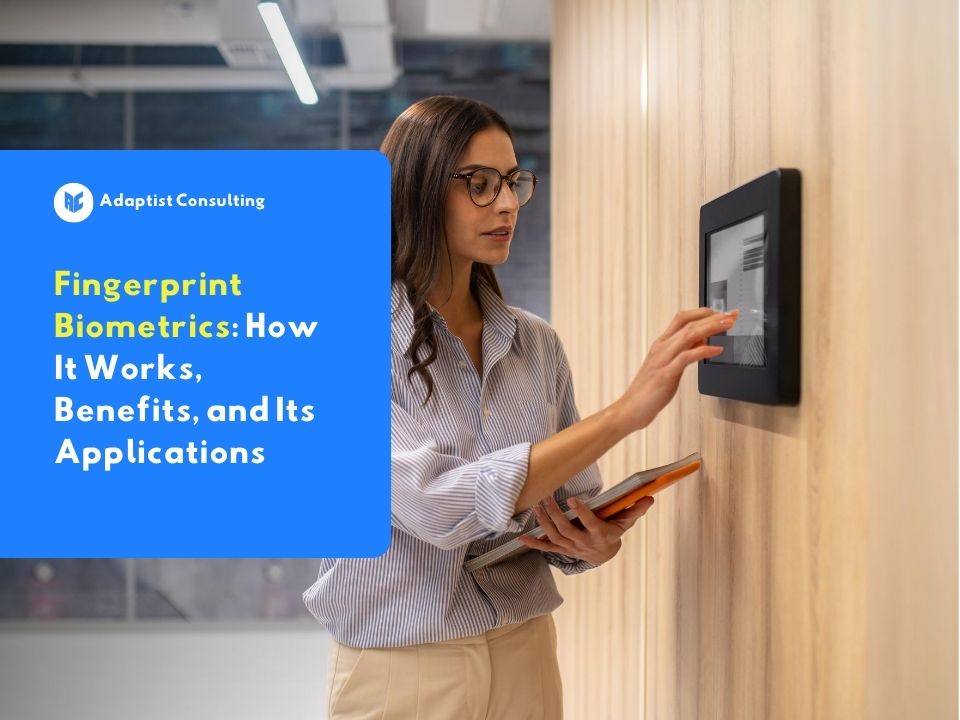
Fingerprint biometrics is one of the authentication technologies that is increasingly being used in various modern security systems. This technology utilizes the unique patterns on each individual’s fingerprints to verify identity quickly and accurately.
Compared to traditional authentication methods such as passwords or access cards, fingerprint biometrics offers a higher level of security because biometric characteristics are unique and difficult to forge. In addition, users do not need to remember passwords or carry additional access cards.
This technology is now widely used in various devices and systems, ranging from smartphones, employee attendance systems, to access control in corporate environments and facilities with high security levels.
What Is Fingerprint Biometrics?
Fingerprint biometrics is an authentication technology that uses the unique pattern of a person’s fingerprint as a verified digital identity.
Unlike passwords that can be forgotten or access cards that can go missing, fingerprints are permanent and biologically tied to each individual.
In the context of digital security, fingerprint biometrics serves as one of the strongest authentication factors in a modern Identity and Access Management (IAM) ecosystem.
This technology does not only identify who the user is, but also ensures that access is granted only to those who are truly authorized.
How Does Fingerprint Biometrics Work?
Technically, a fingerprint biometrics system does not store a photo of the user’s fingerprint, but rather a digital representation of its unique pattern called a template. This process takes place in four sequential stages:
- Enrollment: The fingerprint is scanned for the first time to create a digital template that will serve as the identity reference.
- Feature Extraction: The system extracts unique points (minutiae) such as ridge bifurcations and endpoints from the scanned fingerprint.
- Template Storage: The template is stored in encrypted form, either on a local device or a secure server, and never as the original image.
- Matching & Verification: Each time authentication is performed, a new fingerprint scan is compared against the stored template, if the match score exceeds the defined threshold, access is granted.
Types of Fingerprint Sensor Technology
Not all fingerprint sensors work in the same way. Choosing the right type of sensor depends heavily on the environmental requirements and the level of security the organization needs.
| Sensor Type | How It Works | Advantages | Disadvantages |
|---|---|---|---|
| Optical | Captures fingerprint image using light and a camera | Low cost, easy to implement | Vulnerable to photos or fingerprint replicas |
| Capacitive | Detects electrical charge differences on the skin surface | High accuracy, resistant to fake images | Sensitive to dirty or moist hands |
| Ultrasonic | Uses high-frequency sound waves to map fingerprints in 3D | Highly resistant to spoofing, works in wet conditions | More expensive, more complex integration |
| Thermal | Detects temperature differences between fingerprint ridges and valleys | Reliable in extreme conditions, consistent performance | Less popular, more limited product ecosystem |
Benefits of Fingerprint Biometrics for Organizational Security
Adopting fingerprint biometrics is not simply about modernizing the appearance of a security system. This technology delivers a real impact on an organization’s security posture and overall operational efficiency.
- High identification accuracy
Every person’s fingerprint is statistically unique, resulting in a significantly lower error rate compared to conventional methods. - Non-transferable
Unlike passwords or physical tokens, fingerprints cannot be lent, shared, or stolen without the owner’s knowledge. - Faster authentication process
Verification takes only seconds, reducing productivity friction without compromising security. - Reduces credential theft risk
With no password to remember or store, attack vectors such as phishing and brute force become irrelevant. - Supports audit trail and regulatory compliance
Every access is recorded accurately with a verified identity, making it easier to demonstrate compliance with regulations such as Indonesia’s Personal Data Protection Law (UU PDP).
Fingerprint Biometrics Applications Across Industries
Fingerprint biometrics has been widely adopted across various sectors, from industries managing financial data to public services operating at a national scale.
Each industry has its own unique needs and challenges, yet all of them find the same core value in this technology through high identification accuracy and an efficient authentication process.
Banking & Finance
Fingerprint biometrics has become the standard for customer authentication in the banking sector, both in mobile banking applications and for access to internal services. This technology tightens identity verification while reducing friction for customers who no longer need to memorize long PINs or passwords.
A practical example can be seen in mobile banking apps such as those offered by major banks, where customers can log in and authorize transactions with a single fingerprint tap.
Regulations such as PCI-DSS push financial institutions to adopt layered authentication, and fingerprint biometrics has become a reliable Multi-Factor Authentication (MFA) component within that framework.
Healthcare
Hospitals and clinics use fingerprint biometrics to ensure that only authorized medical personnel can access patient medical records. This goes beyond data security; it is also a matter of clinical accountability that directly relates to patient safety.
A concrete example is the integration of fingerprint biometrics into Hospital Information Systems (HIS), where doctors and nurses must verify their identity before accessing electronic patient records.
In healthcare facilities that have fully implemented electronic medical records, fingerprint biometrics is also used for patient identity verification to prevent administrative errors with potentially fatal consequences.
Government & Public Security
Governments have long been early adopters of fingerprint biometrics technology, from Indonesia’s e-KTP system to international border control. The scale of implementation demands high accuracy and the ability to handle millions of identity records simultaneously.
A clear example is the use of Automated Fingerprint Identification System (AFIS) by law enforcement agencies for forensic identification, as well as fingerprint-based immigration gates at major international airports that significantly speed up the departure and arrival screening process.
In the context of public security, fingerprint biometrics is used by law enforcement for rapid field identification, linking individuals to centralized databases in real-time.
Enterprise & Employee Access Management
Fingerprint biometrics replaces conventional punch card systems and access cards that are prone to buddy punching and forgery in corporate environments. Direct integration with HR systems enables accurate and transparent attendance data.
One common example is its use in manufacturing and banking companies, where fingerprint attendance machines are integrated directly with payroll systems, allowing attendance tracking and salary calculation to run automatically without manual input.
Beyond attendance tracking, this technology is also deployed as physical access control for sensitive areas such as server rooms, R&D laboratories, and archive rooms, ensuring only personnel with the appropriate authorization can enter.
Fingerprint Biometrics vs Other Authentication Methods
Understanding where fingerprint biometrics stands compared to other authentication methods is important before making an implementation decision. Below is a comparison from the perspective of security, ease of use, and cost.
| Method | Column 2 heading | Column 3 heading | Column 2 heading | Column 3 heading |
|---|---|---|---|---|
| Password | Low | High | Very Low | Phishing, brute force, credential stuffing |
| OTP (SMS/Email) | Medium | Medium | Low | SIM swap, intercept |
| Smart Card / Token | Medium | Medium | Medium | Lost, stolen, forgotten |
| Fingerprint Biometrics | High | High | Medium | Spoofing (mitigated by ultrasonic sensors) |
| Multi-Factor Auth (MFA) | Very High | Medium | High | UX complexity, user resistance |
Fingerprint biometrics offers the best balance between security and ease of use compared to other methods. Combined with MFA, it becomes an authentication layer that is extremely difficult to compromise.
Challenges and Considerations in Implementing Fingerprint Biometrics
Fingerprint biometrics implementation still comes with a number of challenges that need to be anticipated from the planning stage.
Understanding these early on will help organizations design a more mature and low-risk adoption strategy.
- Privacy and biometric data protection
Fingerprint data falls under the category of sensitive data protected by personal data protection regulations; its management and storage must meet strict security standards. - Spoofing risk
Low-quality sensors are vulnerable to attacks using fingerprint replicas; selecting a sensor with liveness detection capability is critical. - System interoperability
Integration into an existing IAM or HR system requires careful architectural planning to avoid creating new data silos. - Accessibility
A small number of users may have physical conditions that make fingerprint reading difficult; a well-designed system must provide alternative authentication methods. - Infrastructure and maintenance costs
Physical sensors require periodic maintenance and may add to the IT operational burden if not managed within an integrated ecosystem.
Conclusion
Fingerprint biometrics has already become part of today’s digital security standard, offering high accuracy and ease of use that make it an authentication component difficult to replace in a modern IAM ecosystem.
Its potential is maximized when integrated into a comprehensive identity management platform.
Adaptist Prime is an IAM solution designed to meet that need, combining biometric authentication, Multi-Factor Authentication (MFA), and centralized identity management in one integrated platform.
Ready to Manage Digital Identities as a Business Security Strategy?
Request a demo today and discover how IAM solutions centralize user logins through Single Sign-On (SSO), automate employee onboarding, and protect company data from unauthorized access without disrupting productivity with repeated logins.
With Adaptist Prime, organizations not only secure access, but also ensure every identity is properly managed from the beginning to the end of its lifecycle.
FAQ
No. The system stores an encrypted mathematical template, not the original fingerprint image, so the data cannot be reconstructed back into an image.
Enterprise-grade sensors have a False Acceptance Rate (FAR) of around 0.001% or lower, making it one of the authentication methods with the smallest margin of error.
Temporary changes are generally still handled by the system. For significant permanent changes, a re-enrollment process is required, with a backup authentication method available as an alternative.
Yes, and that combination is exactly what is recommended. Pairing it with a PIN or OTP produces an MFA system that is far stronger and harder to compromise.
This technology is scalable from mid-sized companies to large enterprises. The key lies in infrastructure readiness and proper integration with the existing identity management system.