











Cyber threats no longer just attack servers, but directly target individuals within the company through employee SIM swapping schemes. This mobile number takeover crime has become one of the most damaging threats that can paralyze your corporate assets.
This crime is highly dangerous because hackers exploit communication vulnerabilities without needing physical access to the victim’s device. Therefore, every company must understand how this attack works and its impact to protect their business assets.
What is a SIM Swapping Attack?
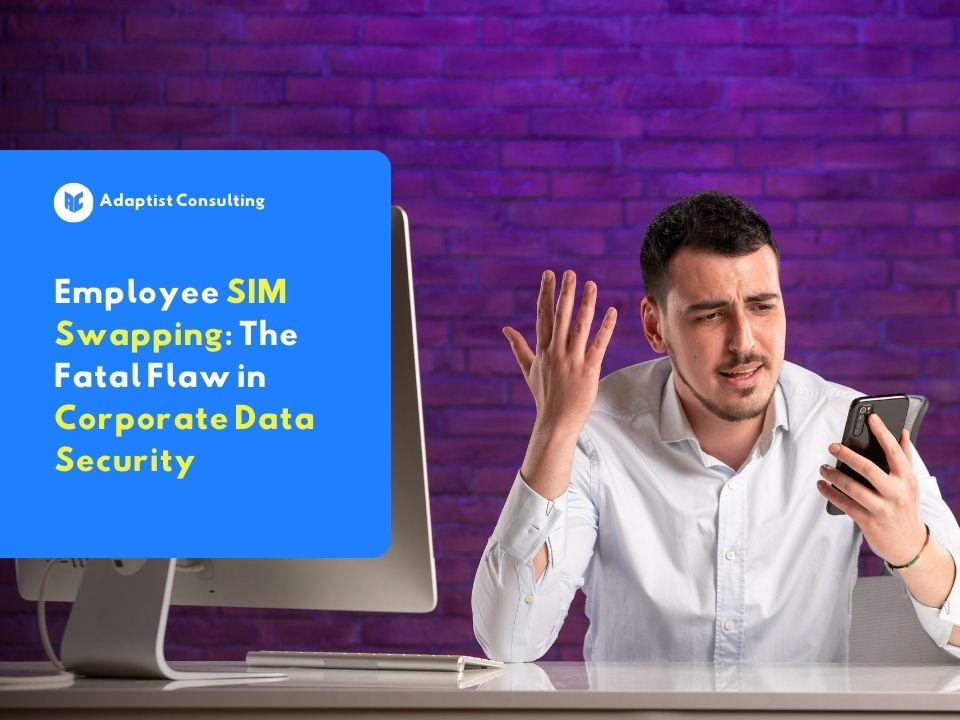
Employee SIM swapping is an advanced fraud technique where hackers take over a victim’s mobile phone number. This crime occurs when perpetrators successfully manipulate mobile network operators into transferring the victim’s number to a new SIM card held by the hacker.
Once the number changes hands, all of the victim’s communication access is instantly cut off from their device. Conversely, the hacker will start receiving all calls, text messages, and One-Time Passwords (OTP) sent to that number.
How Does SIM Swapping Work?
This hacking process does not happen by chance, but through a highly calculated manipulation phase. To successfully execute this employee SIM swapping attack, hackers generally follow these four systematic steps:
- Gathering Employee Personal Data
Hackers usually begin by collecting the target’s personal information through social media or data leaks. Sensitive information like birth dates, mother’s maiden names, or home addresses become their primary weapons. - Executing Social Engineering
Armed with this personal data, the perpetrator contacts the victim’s mobile operator customer service. They will convince the operator by posing as the victim who lost their phone and request a SIM card replacement procedure. - Activating the New SIM Card
If the operator is successfully deceived, they will deactivate the original SIM card used by the employee. Subsequently, the operator’s network will activate the new SIM card that the hacker has physically prepared. - Taking Over Corporate Accounts
Once the new SIM is active, the hacker has full control over the employee’s phone number communication flow. They begin resetting passwords on corporate emails, internal applications, and the company’s VPN portals.
Why Are Employees the Main Target?
Employees are often the easiest entry point for hackers to breach a company’s IT defense system. This usually happens because the user identity lifecycle of employees within the digital ecosystem is not strictly managed.
Furthermore, many companies still rely on SMS as a secondary verification method when employees log in. Consequently, the employee’s personal mobile number turns into a fatal security vulnerability, granting access to sensitive corporate data.
How to Detect Employee SIM Swapping Early
Early detection of suspicious activity on communication devices is the first line of defense for corporate security. Companies must equip employees with the ability to recognize technical anomalies before hackers can breach internal systems.
Understanding these attack symptoms is crucial so the IT team can block access as quickly as possible. Here are the primary indicators employees must watch out for when hackers attempt to hijack their mobile numbers:
- Sudden Loss of Cellular Signal
The employee’s phone suddenly displays a “no service” indicator or can only make emergency calls. Meanwhile, they are in a location that typically has a very stable signal coverage. - Inability to Send or Receive Messages
Employees can no longer use SMS services or make phone calls as usual. All communication access via the cellular network is completely paralyzed without a clear technical reason. - Receiving SIM Replacement Messages from the Operator
Sometimes, operators send a confirmation SMS or email right before the old SIM card is systematically deactivated. If an employee receives a notification for a SIM replacement they never requested, it is an absolute red flag. - Suspicious Login Activity Notifications
Notifications appear regarding login attempts or password changes from unrecognized devices. This indicates that hackers are trying to breach critical accounts using the OTP access sent to the mobile number. - Internal Accounts Suddenly Locked
Employees suddenly cannot log into the company’s VPN portal or corporate email because their passwords are no longer recognized. This condition shows that hackers are already one step ahead in taking over their digital identities.
The Fatal Impact of SIM Swapping on Companies
Incidents of digital identity takeover via employee SIM swapping bring a chain of consequences that risk completely paralyzing business operations.
When verification access falls into the hands of hackers, all layers of corporate data protection automatically face immense danger.
The scale of loss from this incident can threaten financial stability and permanently destroy client trust. Let’s examine the specific, deadly risks threatening companies due to this security vulnerability:
Theft of Sensitive Data
Hackers can freely extract vital corporate information, ranging from customer databases and product blueprints to internal access credentials. Control over these intellectual assets often leads to ransomware threats that hold your business operations hostage.
Beyond extortion, cybercriminals frequently sell this sensitive data on the dark web to malicious third parties. This exploitation automatically strips away the competitive advantage your company has painstakingly built over the years.
The 2025 IBM Cost of a Data Breach report notes that the average global financial loss due to data breach incidents reaches 4.44 million USD.
This surge in mitigation costs confirms that data theft is no longer just a technical IT issue, but an executive-level financial crisis.
Financial Loss from Illegal Transactions
Hijacking a mobile number allows hackers to breach corporate financial portals and manipulate transaction approvals. They can directly drain operational funds or divert vendor payment routes to third-party accounts.
Companies find it incredibly difficult to recover this type of financial loss through standard banking channels. Banks generally consider these transactions legitimate because hackers use a valid authentication system (OTP) from the employee’s recognized device.
Legal Sanctions and Compliance Fines
Customer data leaks resulting from employee identity hacks automatically cause companies to violate strict data privacy regulations. Both local privacy laws and global standards require organizations to maintain the absolute confidentiality of their users’ information.
These data protection violations will inevitably invite sharp scrutiny and comprehensive audits from relevant government authorities.
Regulators will not hesitate to impose massive administrative fines if they find negligence in your company’s access security system.
In addition to state fines, companies risk facing a series of class-action lawsuits from customers whose data was leaked. These legal defense costs can drastically drain operational budgets and limit your business’s room to maneuver in the future
Business Operational Disruption
Handling a cybersecurity incident requires substantial time for investigation and IT system recovery. During the mitigation and audit processes, employee productivity and corporate operations will be significantly hindered.
During the mitigation and audit processes, employee productivity will halt drastically. This operational paralysis directly impacts the company’s ability to meet service targets for clients and partners.
Long-Term Reputational Damage
Clients and business partners will immediately withdraw their trust if their sensitive data is exposed due to identity security negligence. This loss of credibility is an intangible loss with a highly destructive impact on your corporate brand’s good name.
Rebuilding public reputation takes years and requires massive public relations campaign costs. At this vulnerable point, competitors can easily swoop in and take over the market share your company has worked so hard to build.
Steps to Prevent Employee SIM Swapping in the Workplace
Preventing access breaches is always better and cheaper than recovering a hacked system. Here are the tactical steps that your IT team must immediately implement.
- Move Away from SMS-Based Authentication
Stop using SMS for OTP verification because this method is highly vulnerable to interception and diversion. Start mandating the use of authenticator apps or physical security keys for all employees without exception. - Implement Mobile Device Management
Companies must have centralized control over devices used to access corporate data. This solution allows the IT team to securely separate personal and work data spaces within a single handheld device. - Employee Cybersecurity Awareness Education
Employees must be trained regularly to avoid carelessly sharing personal information across various social media platforms.
Reduce the habit of oversharing, which hackers can exploit to craft social engineering scenarios against operators. - Restrict Access with the Principle of Least Privilege
Ensure employees only have access to the systems and data they strictly need for their daily routines. If one account is successfully hacked, the hacker’s lateral movement within the company network will be highly restricted and easy to isolate.
Conclusion
Attacks targeting employee credentials prove that traditional security perimeters are no longer sufficient to withstand modern threats. Therefore, building a solid security foundation is a mandatory investment for the survival of your business operations.
Through the Adaptist Prime product solution from Adaptist Consulting, we are ready to help your company design a resilient identity security architecture.
Ready to Manage Digital Identities as a Business Security Strategy?
Request a demo today and discover how IAM solutions centralize user logins through Single Sign-On (SSO), automate employee onboarding, and protect company data from unauthorized access without disrupting productivity with repeated logins.
With Adaptist Prime, companies can ensure that user identity management is strictly governed so that system access always remains in the right hands.
FAQ
Generally, mobile operators have standard procedures for verifying customer identities before replacing a SIM card. However, because hackers use sophisticated psychological manipulation techniques, companies are still obligated to have their own access security layers.
Yes, hackers can take over corporate communication accounts if the login process still sends links or codes via SMS. Therefore, enabling two-step verification internally is highly crucial to prevent this.
Hackers usually work very quickly, often exploiting access within minutes to hours. They race against time because they know the victim will soon realize the loss of signal and report it to the operator.
The use of eSIM offers slightly different management procedures, but it does not make user numbers completely immune. Skilled hackers can still use social engineering on operators to transfer the eSIM profile to another device they own.
Employees must quickly contact the company’s IT team and the mobile operator’s customer service using a different phone. The next mitigation step is for the IT team to freeze all corporate account access and sever the VPN connection from that device.