Privacy management software is an application category that helps organisations manage the personal data lifecycle, from recording processing activities to responding to data subject requests, without relying on spreadsheets or manual processes that are easy to lose track of. A single tool rarely covers every one of these needs on its own.
Indonesia’s PDP Law requires a data controller to report a personal data protection failure within 3×24 hours of discovering it. That tight a deadline is hard to meet if a company doesn’t know exactly which type of tool handles which part of its compliance process.
Understanding privacy management tools starts with understanding their types, since each one solves a different problem. This article maps out 6 types of tools, then closes with a few concrete recommendations worth considering.
What Is Privacy Management Software?
Privacy management software is a category of applications built specifically to help organisations meet their legal obligations around personal data processing, rather than general-purpose data security tools. As with the PDP Law’s other obligations, these obligations apply extraterritorially, so a foreign company can fall within scope simply by processing the personal data of people in Indonesia.
Unlike a spreadsheet or a manual document, this kind of software logs every action automatically and can be shown to a regulator as compliance evidence at any time. That audit trail capability is what most separates privacy management software from a basic record-keeping tool.
6 Types of Privacy Management Tools by Function
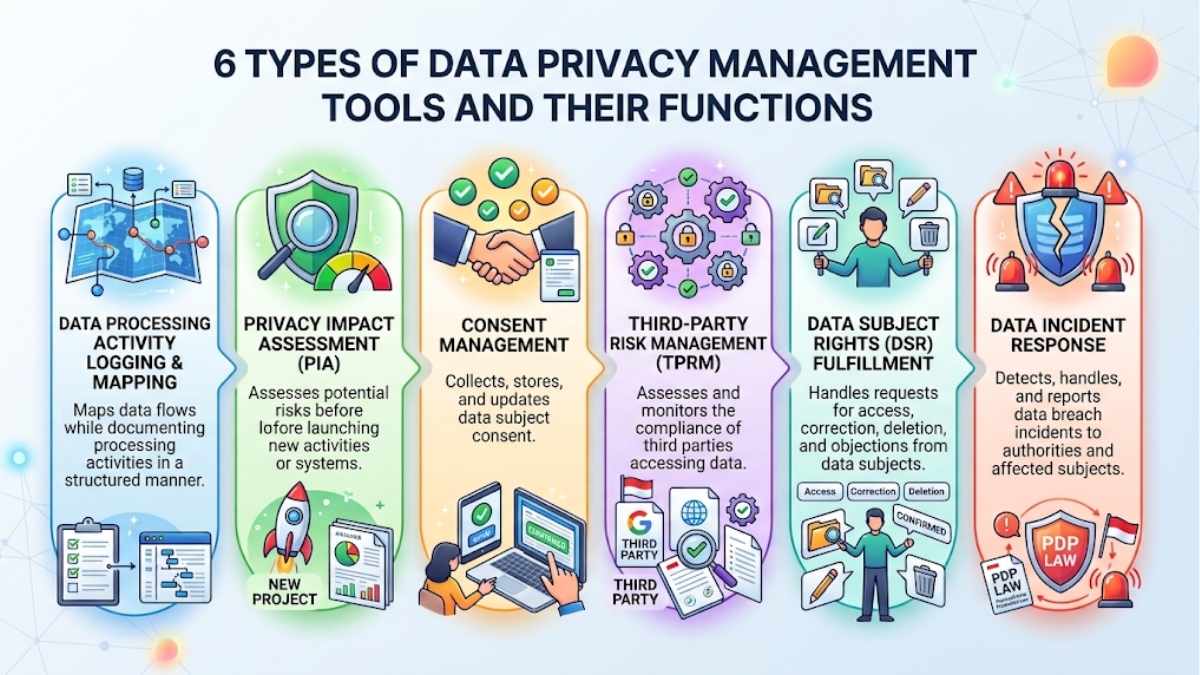
Each type of privacy management tool is built to solve one specific compliance problem, not everything at once. The table below maps out all 6 types along with their core function.
| Type of Tool | Core Function |
|---|---|
| Processing Records & Data Mapping | Maps data flows and formally documents processing activities |
| Privacy Risk Assessment | Assesses potential risk before a new activity or system goes live |
| Consent Management | Collects, stores, and updates data subject consent |
| Third-Party Risk Management | Assesses and monitors the compliance of vendors accessing data |
| Data Subject Rights Fulfilment | Handles access, correction, deletion, and objection requests |
| Incident and Breach Management | Detects, manages, and reports data breaches to regulators and affected individuals |
These 6 types complement rather than replace one another. Accurate processing records and data mapping, for instance, is what makes privacy risk assessment and incident response significantly easier to carry out.
Why Spreadsheets and Manual Processes Fall Short
A spreadsheet can work fine as long as the data being managed is limited and few people need access to it. The trouble starts once data is scattered across many systems and compliance requests come in faster than one person can keep up with.
- Document versions easily fall out of sync once more than one person edits them at the same time.
- There’s no automatic audit trail showing who changed what data and when.
- Updates to data mapping get delayed for months because there’s no automated reminder to do it.
- Cross-team collaboration slows down because files live in separate places and versions can drift apart.
- Compliance evidence is hard to pull together quickly when an auditor asks for it on short notice.
How to Choose the Right Combination of Tools for Your Compliance Needs
Choosing privacy management tools should start from the most urgent compliance need, not from whichever vendor has the longest feature list. Here are 4 steps worth using as a guide.
1. Map the Types of Data and Risk Most Relevant to You
Start by identifying which categories of personal data your company processes most and which activities carry the highest risk. A company that handles a lot of health data, for example, will need privacy risk assessment more urgently than one whose data is relatively simple.
2. Prioritise the Tool Type That Closes the Biggest Gap
There’s no need to adopt all 6 types at once from day one, just start with whichever closes the most pressing compliance gap. A company that regularly receives data subject requests, for instance, should prioritise data subject rights fulfilment first.
3. Make Sure the Tools Can Actually Connect to Each Other
All 6 types above ideally work from the same underlying data, rather than sitting in separate systems that don’t talk to each other. A fragmented setup forces a team to enter the same data repeatedly across different places.
4. Fit the Tool to Indonesia’s Regulatory Context, Not Just Global Frameworks
Many privacy tools are built around the GDPR framework, which isn’t always identical to Indonesia’s PDP Law. Make sure the tool you choose supports the terminology, workflows, and deadlines specific to the PDP Law, rather than a straight translation of another jurisdiction’s framework.
Recommended Privacy Management Tools
Once the types of needs are clear, the next step is looking at concrete options on the market. Here are 3 tools that represent different approaches to meeting privacy management needs.
Adaptist Privee
Adaptist Privee is a GRC platform built around Indonesia’s regulatory context, covering all 6 categories above through its ROPA, PIA, Consent and Preference Management, TPRA, Data Subject Right, and Data Breach and Incident Management modules. This approach fits companies that want their terminology and workflows to genuinely follow the PDP Law, rather than an adaptation of another country’s framework.
OneTrust
OneTrust is one of the broadest privacy management platforms globally, covering consent management, data mapping, risk assessment, and third-party risk management within a single platform. Its regulatory coverage spanning hundreds of jurisdictions makes it a better fit for multinational companies operating across many countries.
TrustArc
TrustArc focuses on mapping and monitoring data flows alongside privacy risk management, with automated data inventories and compliance reporting. The platform is typically used by mid-to-large companies that need centralised oversight of data use without the complexity of a full global enterprise suite.
Read also: 7 OneTrust Alternatives for Indonesian Companies, Plus One Option From Us
Conclusion
Privacy management software isn’t a single product, it’s a combination of 6 complementary needs, from processing records to incident response. Understanding these types first helps a company avoid paying for features it doesn’t actually need at the early stage.
The right combination of tools will look different for every company, depending on the type of data and risk it faces most, and the regulatory context it operates in. What stays constant is the need for all 6 types to work from the same underlying data, rather than being scattered across disconnected systems.
Ready to Manage Privacy Compliance as a Business Risk?
See how GRC helps map personal data risks, monitor compliance with the PDP Law, and prepare companies for audits without complicated manual processes.
FAQ
Not from day one, it’s fine to start with whichever type closes the most urgent compliance gap.
The two are often combined into one module, where mapping data flows is part of the process of completing a ROPA rather than a separate step.
Not necessarily, since the terminology, workflows, and deadlines under the PDP Law don’t always match GDPR.
Potentially, yes. The PDP Law applies extraterritorially, so processing the personal data of people in Indonesia can bring a foreign company into scope regardless of where it’s based.
A team ends up entering the same data repeatedly across different systems, and the risk of that data falling out of sync gets larger.